Simple Wave Electric Scooter Review: 66L Boot, Real Road Pull and Honest Verdict
Most electric scooters in India force you into an annoying choice: pick something fast and sharp with no luggage space, or settle for a sluggish commuter that barely pulls a pillion up an incline.
Simple Energy wants to flip that script with the new Simple Wave.
The headline claims sound massive: an enormous 66-litre boot cavity, battery packs spanning 2.2 kWh up to 5 kWh, and an introductory rate sitting right at the ₹1 Lakh threshold.
We swung a leg over the 3.7 kWh trim along the twisting climbs of Nandi Hills to find out what holds up and what falls flat.
Styling and Road Presence
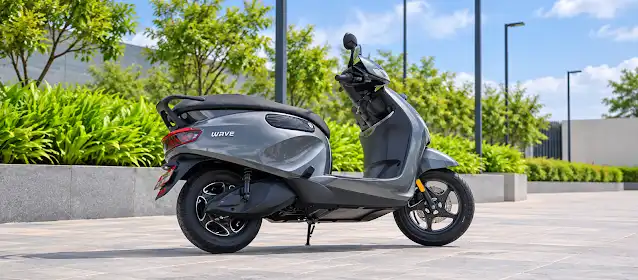
From the front apron, the Wave takes styling inspiration from modern cars. The face packs twin LED projectors framed by low daytime running strips, while the turn signals sit clean up near the handlebar.
Rolling gear includes neat 12-inch alloys, a 220 mm front disc with a Combined Braking System, and a basic drum at the back. Along the flanks, crisp stamping lines feed into 3D Wave badges. The back section looks sharp too, using crystal-cut tail lamps that light up nicely after dusk, held steady by solid cast-iron mirror stems instead of cheap plastic stalks.
That Enormous 66-Litre Boot
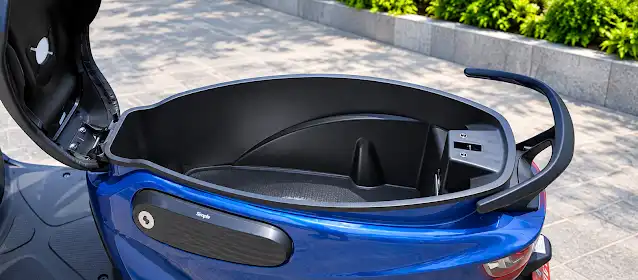 Storage is where this scooter leaves the rest of the market behind.
Lift the seat, and you find an unmatched 66-litre boot volume. You can toss in two full-face helmets side by side and still have empty room left over for bags or gym clothes.
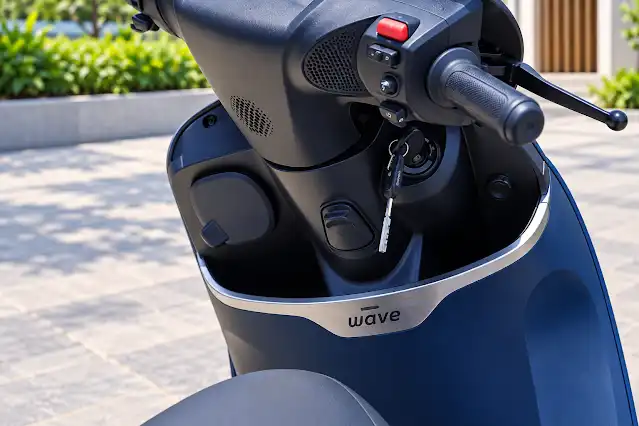
Up front, Simple moulded two deep apron pockets give you 4 litres of quick storage for bottles or a large phone. Right beside those cubbies sits a USB-A socket to charge your handset while riding, along with the scooter’s main charging inlet.
Saddle Height and Daily Ergonomics
The riding stance leans heavily toward family usability:
- Saddle Height: Set at a friendly 770 mm, so average-height riders plant both feet flat at traffic lights without tipping.
- Kerb Weight: Sits right around 121 kg, making it easy to haul onto the centre stand.
- Floorboard Space: Enough room for daily groceries, though taller riders above six feet will feel their knees tucking slightly close to the bar on tight turns.
Before picking up any fresh electric two-wheeler from the dealer, run through our Electric Car PDI Checklist guide to check body gaps, harness connections, and software setup before signing the handover papers.
Why Skipping a Touchscreen Actually Works
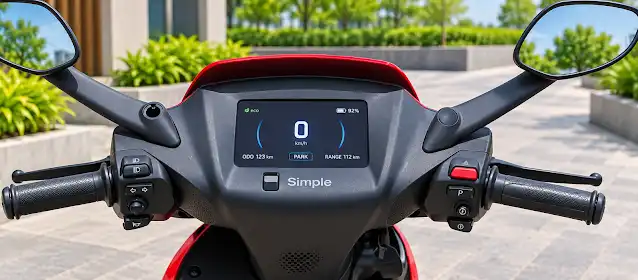
Rather than bolting on a delicate touchscreen that stutters under heavy rain or harsh afternoon glare, Simple went with a straightforward 7-inch colour display.
You control the entire dash menu using a physical joystick toggle next to your left thumb. It feels robust, clicks positively, and keeps your eyes pointing down the road.
The screen packs smart essentials like geo-fencing warnings, theft alerts, towing tracking, and a direct switch to toggle traction control on or off whenever rain hits the tarmac.
Motor Output, Battery Packs and Charging
At the heart of the powertrain is a mid-mounted Permanent Magnet Synchronous Motor. Simple engineered it without rare-earth magnets, transferring drive straight to the rear wheel through an exposed chain setup instead of a rubber belt.
Factory figures give you:
- Peak Power: 6.4 kW
- Motor Torque: 52 Nm
- On-Wheel Torque: A solid 179 Nm
Battery Chemistry Setup
Simple separated the battery chemistry depending on which variant you buy:
- The entry-level 2.2 kWh and 2.7 kWh versions: Get Lithium Iron Phosphate (LFP) cells engineered to cope with tough thermal conditions.
- Higher Trims (3.7 kWh & 5.0 kWh): Use energy-dense Nickel Cobalt Aluminium (NCA) chemistry for maximum range extraction.
Home Charging and Long Warranty
A 750W portable travel charger comes bundled in the box. Juicing from flat to 80% takes roughly 4 to 4.5 hours on a 15A domestic socket, while a full 100% soak takes around 5.5 hours.
Simple backs the battery with an extensive 8-year or 80,000 km warranty package. To see how electric running numbers stack up against petrol running costs over five years, our breakdown comparing an Electric Scooter vs Petrol Bike puts everyday fuel savings into clear focus.
Ride Impressions: Modes, Curves and Real Limitations
Hit the starter toggle and the mid-drive motor hums to life with negligible vibration through the floorboard.
You get four distinct ride profiles:
- Eco X Mode: Primarily a limp-home safety map for when charge drops low, though it still lets you clip along at 74 km/h to keep pace with traffic.
- Eco Mode: Caps top speed around 54–55 km/h, tuned strictly for squeezing out distance.
- Ride Mode: The sweet spot for city work. Throttle response has a momentary, gentle pause under 20 km/h to keep things smooth, followed by a healthy pull up to 65 km/h. It softens briefly near 70 km/h before giving you another clean surge past 80 km/h.
- Sport Mode: Frees up the full 6.4 kW output, pushing quickly up to its 90 km/h speedometer ceiling.
Handling Dynamics on Road
Throwing the Wave into Nandi Hills’ hairpins showed genuine chassis balance. Riding on a 1,347 mm wheelbase backed by twin rear shock absorbers, it tracks flat and predictable through corners.
With an adult riding pillion, the rear shocks swallow broken patches without bottoming out. The only odd trait shows up on dead-straight, smooth roads: there is a slight high-frequency “jiggly” chassis sensation. It never feels unsafe, but you do notice it coming off a petrol scooter.
Climbing Power
On steep uphill gradients, the scooter held 55 km/h with confidence. Push past 70 km/h on extended climbs, however, and the electronics begin dialling back output to keep motor temperatures in check.
Expected Price and Early Verdict
Simple is pricing the base 2.2 kWh LFP trim around ₹1.00 Lakh ex-showroom, while the larger 3.7 kWh model we tested should hover near ₹1.50 Lakh.
If you need a genuine family scooter that finally wipes out helmet storage worries with a 66-litre luggage bay, carries an 8-year warranty, and still hits an honest 90 km/h top speed, the Simple Wave makes absolute sense.
Assuming Simple nails their delivery timelines and showroom support, this scooter has the hardware to give established players a serious run for their money.
Common Buyer Queries
How much does the base Simple Wave cost?
The entry 2.2 kWh LFP trim starts right around ₹1.00 Lakh ex-showroom, while the bigger 3.7 kWh variant sits closer to ₹1.50 Lakh.
Can that 66-litre boot actually swallow two helmets?
Yes. The under-seat compartment easily fits two full-face helmets together, plus you get 4 litres of extra pocket space on the front apron.
What is the real top speed?
Sport mode pushes you to an honest 90 km/h, while daily Ride mode gives you solid mid-range acceleration up to 65 km/h.
Why did Simple skip a touchscreen?
They chose a sturdy 7-inch non-touch display run by a physical handlebar joystick, avoiding the lag and glare issues common with touch panels in rain and bright sun.
How long does a home charge take?
Using the bundled 750W travel charger, it takes about 4 to 4.5 hours to hit 80%, with a complete 100% top-up taking roughly 5.5 hours.