MG Hector Tomahawk EV vs Tata Sierra EV: Which ₹23 Lakh Electric SUV Should You Buy?
Spending ₹23–25 lakh on an electric SUV gives you some interesting choices now. Two of the cars that stand out are the MG Hector Tomahawk EV and the Tata Sierra EV.
They are similar in price, but that is where most of the similarities end.
MG has priced the Hector Tomahawk EV Essence at ₹23 lakh ex-showroom. Tata starts the 75 kWh range with the Sierra Adventure 75 at ₹22.19 lakh, while the mid Empowered 75 sits at ₹23.79 lakh and the top Empowered A 75 comes in at ₹24.79 lakh.
So, should you save money with the MG, or is the extra amount for the Sierra actually worth paying?
Size, Space and Practicality
The Hector is the larger SUV, and you can tell that even before getting inside.
Measuring 4,745 mm in length and 1,850 mm across, it’s a fairly substantial car. The 2,810 mm wheelbase gives it plenty of room inside, while the 230 mm ground clearance should be useful on India’s rougher roads.
The biggest advantage, though, is the third row. The Hector can carry seven people, making it a more obvious choice for a large family. Depending on the seating arrangement, boot space is around 579–610 litres.
The Sierra is a much smaller SUV. At 4,340 mm long, it is around 405 mm shorter than the MG.
That sounds like a big disadvantage, but it isn’t necessarily one. The shorter body makes the Sierra easier to handle in crowded city areas and tighter parking spaces.
Tata has also used the available space quite well. There is a 622-litre boot at the back and a 35-litre frunk at the front. The latter should be handy for charging cables, small bags or anything you don’t want mixed in with the main luggage.
Ground clearance stands at 205 mm on the Sierra.
For a family that actually needs seven seats, there isn’t much to think about here. The Hector wins. If you normally travel with four or five people and spend most of your time in the city, the Sierra’s smaller size starts to make more sense.
Battery, Range and Performance
Under the skin, the two SUVs take a different route.
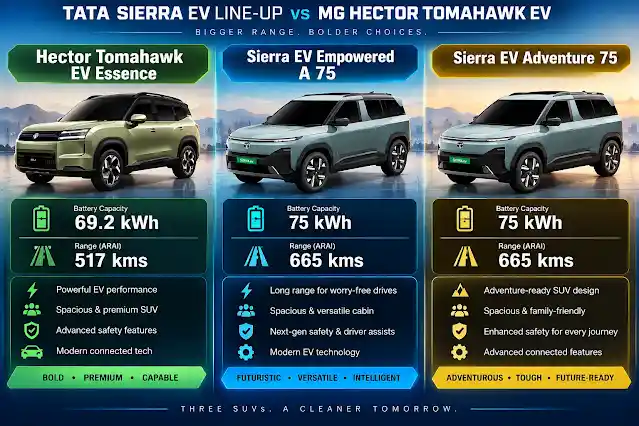
Under the bonnet, the Hector Tomahawk EV gets a 69.2 kWh LFP battery and a front-mounted motor that sends 204 PS and 310 Nm of torque to the front wheels.
MG quotes a claimed range of up to 517 km on a single charge.
As usual, the claimed figure shouldn’t be treated as a guaranteed highway range. With air-conditioning running and normal motorway speeds, somewhere around 400–450 km would be a more realistic expectation.
The Sierra uses a 75 kWh LFP battery, so it has a little more capacity than the MG. Its motor produces 209 PS and 315 Nm, and the power goes to the rear wheels.
Tata’s claimed MIDC range is 665 km.
In normal driving, around 500 km is a more useful number to keep in mind. Actual range will still depend on speed, traffic, temperature and how heavily you use the air-conditioning.
There is also a noticeable difference in the way they drive.
The rear-wheel-drive Sierra should feel more balanced when you take a corner at speed. It has a slightly more eager character, too. The Hector is more relaxed. Its front-wheel-drive layout and smooth power delivery suit someone who would rather have an easy, comfortable drive than chase cornering speeds.
For a long highway trip, the Sierra’s bigger battery could be a genuine advantage. This could give you roughly another 50–75 km of usable range before the next charge.
Charging and Home Backup
This is one area where Tata has a useful advantage.
The Sierra can accept up to 120 kW from a compatible DC fast charger. Tata quotes around 26 minutes for a 20–80% charge.
The Hector supports up to 90 kW DC charging and takes around 35 minutes for a 30–80% charge.
Those numbers won’t matter much on a normal day if the car is sitting at home overnight. When you’re covering long distances, the shorter charging time could save you some waiting around.
At home, charging performance is broadly the same. The Hector uses a 7.4 kW AC onboard charger, compared with 7.2 kW in the Sierra.
Both cars support V2V and V2L. In simple terms, you can use the battery to supply power to compatible equipment and devices.
The MG has another useful feature: V2H.
That allows the car to supply power to selected household appliances during a power cut. It is not something you will use every day, but for some owners it could be a very useful feature.
Interior and Technology
The cabins are quite different as well.
MG has gone with a large 15.6-inch portrait touchscreen in the Hector. It runs the company’s i-SMART 3.0 system and sits above an 8.8-inch digital instrument display.
For music, there is a 10-speaker Infinity sound system.
The Sierra Empowered A 75 goes for a more modern dashboard. Tata’s Horizon View arrangement uses three screens, along with a 12.3-inch display.
It also gets a 12-speaker JBL audio system.
The cheaper Sierra Adventure 75 is less extravagant. It gets a dual-screen setup and a 10.25-inch instrument display. Some of the seat adjustments are manual as well.
That means the difference between the two Sierra variants is worth remembering before you choose one.
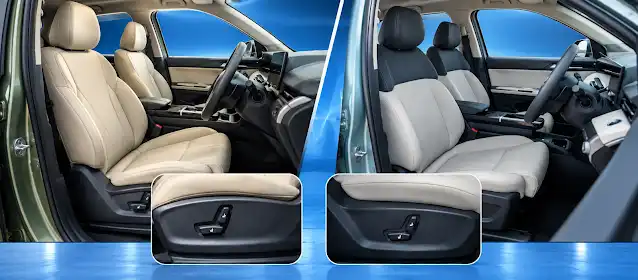
The Hector Essence and Sierra Empowered A 75 both get electrically adjustable front seats, so neither should leave you wanting for basic comfort on longer drives.
Ride and Safety
Indian roads are a good test of any SUV’s suspension, and these two cars have slightly different ideas about how to deal with them.
The Hector uses a multi-link rear suspension tuned towards comfort. It is designed to take the edge off potholes and broken surfaces without making the occupants work too hard.
Tata has taken a slightly different approach with the Sierra.
It also uses an independent multi-link rear setup, but adds Frequency Selective Damping, or FSD. The system is intended to keep the body under better control when the road surface becomes uneven.
That should give the Sierra a more planted feel at higher speeds, especially on undulating expressways.
The Hector remains the softer and more relaxed option. For everyday city driving, that could actually be what some buyers prefer.
Safety equipment is strong in both cars. You get six airbags, ESP, tyre-pressure monitoring and Level 2 ADAS with Adaptive Cruise Control.
The Sierra adds a 540-degree transparent-view system and Blind Spot View monitoring. Safety is another strong point, with a 5-star Bharat NCAP rating.
For either car, don’t rush through the pre-delivery inspection. Check the paint, panel gaps, charging ports, and electrical systems before signing off the delivery. With an EV, it is worth making sure everything works properly from day one.
So, Which One Makes More Sense?
This is actually a fairly easy comparison once you decide what matters most to you.
The MG Hector Tomahawk EV is the more practical choice for a big family. You get three rows, more overall size, 230 mm of ground clearance, and a ₹23 lakh starting price. The V2H feature is another nice addition.
The Tata Sierra EV is more appealing if you spend a lot of time on the highway. Its larger battery, rear-wheel-drive layout and 120 kW DC charging give it a stronger long-distance package.
The top Sierra Empowered A 75 costs ₹1.79 lakh more than the Hector Essence. That is not a tiny amount, but you are getting more range and a better-equipped package in return.
There is also the Mahindra XEV 9S to consider, although its roughly ₹29.95 lakh price puts it in a different budget bracket.
Final Verdict
If your main concern is space, seven seats, and value, go for the MG Hector Tomahawk EV Essence. At ₹23 lakh, it makes a strong case as a family-focused electric SUV.
If you can stretch the budget and spend more time covering highways, the Tata Sierra EV Empowered A 75 is the one I would pick. The extra range, faster charging, and rear-wheel-drive setup make it the more convincing all-round package.
The Hector is the better family hauler. The Sierra is the better choice for people who regularly travel long distances.
MG Hector Tomahawk EV vs Tata Sierra EV: Common Buyer Queries
How much actual cash are we talking about here?
MG keeps the invoice straightforward with a flat ₹23 lakh ex-showroom sticker for the Hector Tomahawk EV Essence. Tata starts the 75 kWh battery Sierra line up around ₹23.79 lakh, climbing up to ₹24.79 lakh for that loaded Empowered A 75 trim.
Will the Sierra genuinely drive further on highway runs?
Without a doubt. Tata squeezed in a 75 kWh battery rated for 665 km on paper, giving you roughly 500 km of honest tarmac cruising. The Hector carries a slightly smaller 69.2 kWh unit claiming 517 km, which settles closer to 400–450 km once your AC blowers start working hard.
Can the shorter Tata actually carry your vacation bags?
Surprising as it sounds, yes. Even though the Hector stretches 405 mm longer with three seating rows, the Sierra hands you a massive 622-litre rear hold plus a separate 35-litre frunk up front. The Hector manages between 579 and 610 litres depending on how you slide that third row around.
Does either SUV plug in faster on expressway chargers?
The Sierra pulls ahead on fast corridors, handling up to 120 kW DC current to jump from 20% to 80% charge in about 26 minutes. The Hector maxes out around 90 kW DC, taking roughly 35 minutes to push from 30% to 80%.
What makes the Hector’s power sharing special?
Both vehicles happily run camping gear using V2L and V2V power delivery. The Hector pulls an extra trick with Vehicle-to-Home (V2H) hardware, letting you feed battery power straight back into your house wiring whenever local power lines trip.