MG Hector Tomahawk EV vs Mahindra XEV 9S: Which Electric SUV Makes More Sense?
Look, finding a proper seven-seater electric SUV in India without spending German luxury car money used to be impossible. That changed the moment JSW MG dropped the Hector Tomahawk EV onto the market with prices starting under twenty lakh rupees. It sits right in the crosshairs of Mahindra’s purpose-built electric flagship, the XEV 9S.
Both want to be your primary family car for messy school runs and weekend road trips. But the way they drive, charge, and seat your family is night and day.
Before committing serious money to an electric family hauler, going through our car buying guide for India is worth doing to understand ownership costs and charging realities over time.
Road presence, cabin room, and everyday ground clearance
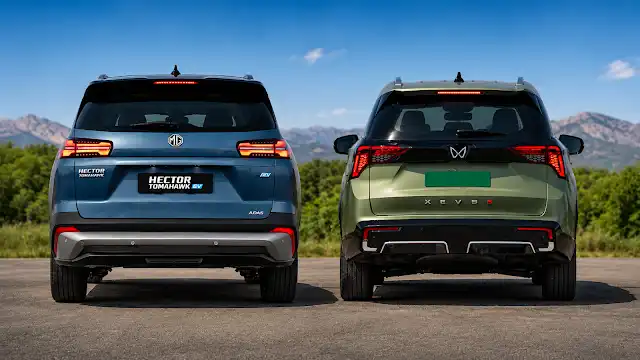
The Hector Tomahawk EV looks like a traditional, massive road cruiser. It sits 4,745 mm long and 1,770 mm tall, riding on a long 2,810 mm wheelbase.
What you notice immediately over nasty potholes is the massive 230 mm ground clearance. That is huge. You sit upright, stare right over smaller hatchbacks, and breeze through flooded monsoon roads without worrying about battery scrapes.
Mahindra’s XEV 9S is nearly the same length at 4,737 mm, but it looks far more aggressive and rakish. It sits lower to the tarmac to slice through wind at high motorway speeds.
Boot space works fine on both. Keep all three rows upright, and the Hector gives you 192 litres of space, which jumps to 528 litres when you drop the third row. The XEV 9S offers 220 litres behind row three. Enough for soft weekend bags, but not much else.
To see how battery setups and high-voltage platforms are evolving across Indian cars, our tracker on upcoming electric and hybrid cars in India breaks down where the industry is heading.
Batteries, real-world highway range, and outright punch
MG kept things dead simple. You get one single 69.2 kWh battery pack hooked to a front motor. The engine delivers 201 bhp and 310 Nm of torque.
MG claims 517 km on paper. But let us be honest here. With the air-con blasting on Indian highways, you should realistically expect to cover around 400 to 430 km between charges.
Mahindra gives you three battery setups on its dedicated INGLO skateboard frame:
- 59 kWh pack: Makes 228 bhp and 380 Nm. ARAI claims 521 km, but 390 km is what you get in real traffic.
- 70 kWh pack: Bumps power up to 241 bhp with the same 380 Nm torque, claiming 600 km certified.
- 79 kWh flagship: Cranks out a massive 282 bhp and 380 Nm. On paper, it says 679 km. Out on open expressways, it comfortably crosses 480 km on a single charge.
Straight up, if you do frequent cross-state road trips, the 79 kWh XEV 9S pulls away with effortless overtakes.
Charging speeds and domestic backup power
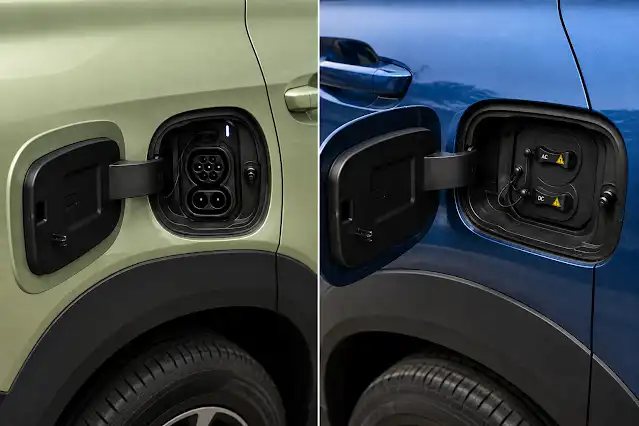
Long waits at public chargers ruin family holidays. MG supports 90 kW DC fast charging, pushing the Hector from 30% to 80% in roughly 35 minutes. At home on a normal 7.4 kW AC box, expect a full charge to take about 12.5 hours overnight.
The XEV 9S charges faster on modern highway stations. Hook it to a compatible 140 kW or 180 kW DC stall, and it pulls a 20% to 80% charge in about 20 minutes flat.
Still, MG brings a clever party trick to the table. The Hector supports bi-directional Vehicle-to-Home and Vehicle-to-Load power. If your house suffers a power cut, the car can literally run your essential domestic lights, fans, and appliances straight off its big 69.2 kWh battery.
Cabin feel and dashboard layout.
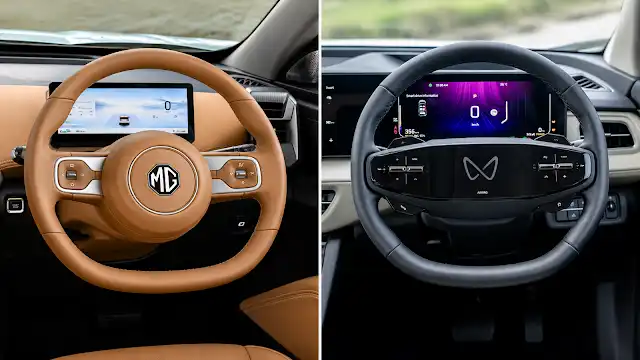
Step inside, and both cabins feel like they were made for two completely different buyers.
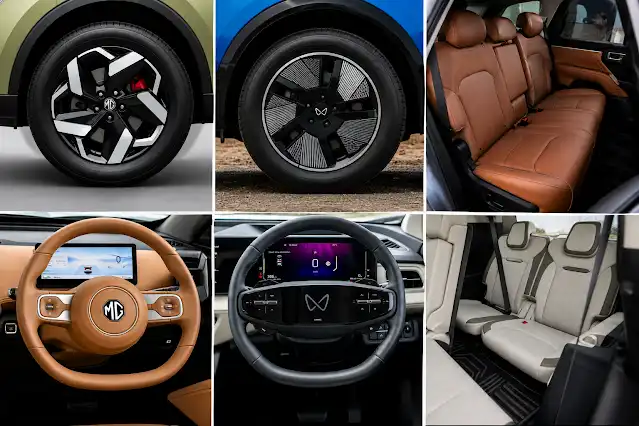
The Hector Tomahawk EV feels like a plush living room. You get soft tan-leather seats, deep sofa cushioning, and a massive 15.6-inch portrait touchscreen. It comes with 10 Infinity speakers, plus quirky lifestyle modes like Nap Mode, Pet Mode, and built-in karaoke for traffic jams.
The XEV 9S looks like a high-tech flight cockpit. Three 12.3-inch digital displays stretch completely across the dashboard. You get cooled seats in the front and middle rows, dual-zone climate controls, and a 16-speaker Harman Kardon sound setup running Dolby Atmos.
Safety kit and crash protection
Safety equipment is reassuringly heavy on both cars. You get Level 2 ADAS including Adaptive Cruise Control, Lane Keep Assist, and Autonomous Emergency Braking.
The XEV 9S offers up to 7 airbags and uses Mahindra’s INGLO architecture, which carries a 5-star Bharat NCAP pedigree. The Hector Tomahawk EV packs 6 airbags, disc brakes all around, and a 360-degree camera with a see-through chassis view.
Price and the final verdict
The Hector Tomahawk EV sits tightly between ₹19.49 lakh and ₹23.49 lakh ex-showroom. MG’s battery rental scheme also cuts the entry price down to ₹13.99 lakh. Mahindra spreads the XEV 9S from ₹19.95 lakh all the way to ₹29.45 lakh for top trims.
To be fair, if your family wants couch-like seat comfort, massive 230 mm ground clearance, and home emergency backup power, the MG Hector Tomahawk EV is the more comfortable and budget-capped buy.
However, if you want blistering 282 bhp acceleration, rapid 20-minute highway charging, and a genuine 480+ km touring range, the Mahindra XEV 9S is the better long-distance electric SUV.
Here is our genuine take: if your daily routine involves broken city roads, elderly family members needing soft seating, and home power backup during blackouts, the MG Hector Tomahawk EV is the more comfortable daily companion. But if you want strong 282 bhp highway punch, fast 20-minute charging, and long-range touring, the Mahindra XEV 9S is the one to pick
Common Questions
What real-world range can you expect from the MG Hector Tomahawk EV?
MG claims 517 km under the MIDC testing cycle. In normal driving, especially with the air conditioner running, around 400-430 km is a more sensible expectation depending on traffic and highway speeds.
Which SUV charges faster?
The Mahindra XEV 9S has the advantage when using a high-output DC charger. Compatible versions can accept up to 180 kW and take roughly 20 minutes to go from 20% to 80%. The Hector Tomahawk EV takes around 35 minutes for a 30-80% DC charge under the stated conditions.
Can the Hector Tomahawk EV power appliances at home?
Yes. Its V2H technology allows electricity to be supplied from the vehicle’s 69.2 kWh battery to compatible household equipment. This could be particularly useful during a power cut, provided the required home setup and compatible equipment are in place.