Buying a Car in India: Crash Tests, Fuel Math, and What Actually Matters
Buying a new car in India right now feels messy. Showrooms push hard, launch rumours never stop, and the fuel options keep changing with every passing month. A lot of buyers end up stuck in the exact same traps — is a strong hybrid really worth that ₹2 to ₹3 lakh premium? Does a five-star crash rating mean what people think it means? And which size car actually fits your daily driving without draining your wallet?
You don’t need marketing noise or corporate brochures. What you actually need is clear numbers, realistic service routines, and an honest look at how Indian roads and traffic work.
If you’re also watching how the wider market is gradually moving toward alternative powertrains, keeping an eye on upcoming electric and hybrid cars in India helps put the whole decision into long-term perspective.
Bharat NCAP vs Global NCAP: What Really Changed

For a long time, people treated those international crash-test stickers as the absolute final word on safety. The problem was that the testing model had a few obvious loopholes behind the scenes. In several cases, third parties or rival entities could privately sponsor a test on a competitor’s car, and those results were then pushed hard in social media perception battles.
Bharat NCAP cleaned that system up with three clear protocols:
- Direct Manufacturer Submissions: Only the car company itself can submit its vehicle for voluntary testing. Competitors cannot fund a test just to run a smear campaign or make someone else look bad.
- Matched Testing Standards: The actual physical crash protocols — offset deformable barrier impacts, side movable barrier tests, side pole crashes, and child occupant protection — are fully aligned with global standards without cutting corners.
- Structural Reality: Most modern platforms are already engineered for these crash loads from the design board. That is why well-built chassis score four or five stars predictably, while older platforms struggle.
Hybrid, CNG, or Normal Petrol: Do the Maths First
Too many buyers pay a massive upfront premium for strong hybrids or factory-fitted CNG kits without ever sitting down to calculate their real monthly kilometres.
- Under 1,000 km Monthly Running: If you only drive 300 to 800 km a month, that ₹2 to ₹3 lakh hybrid price gap rarely breaks even. You will spend far more on higher road tax, higher annual insurance premiums, and faster early depreciation than you will ever save on petrol. A simple naturally aspirated petrol or a mild turbo-petrol is far cheaper to own over five years.
- Low Annual Mileage (Under 200–300 km a Month): If your total yearly running is under 2,000 to 3,000 km, buying a ₹15 lakh car is essentially a money sink. When you add up insurance, road taxes, regular service bills, and vehicle depreciation, taking app-based cabs for occasional trips is the smarter financial move.
- Highway Driving (Over 1,500 km Monthly): Only when you are regularly crossing 1,500 to 2,000 km every month do higher-mileage options like diesel, factory CNG, or dedicated battery crossovers start recovering their initial cost within four to five years.
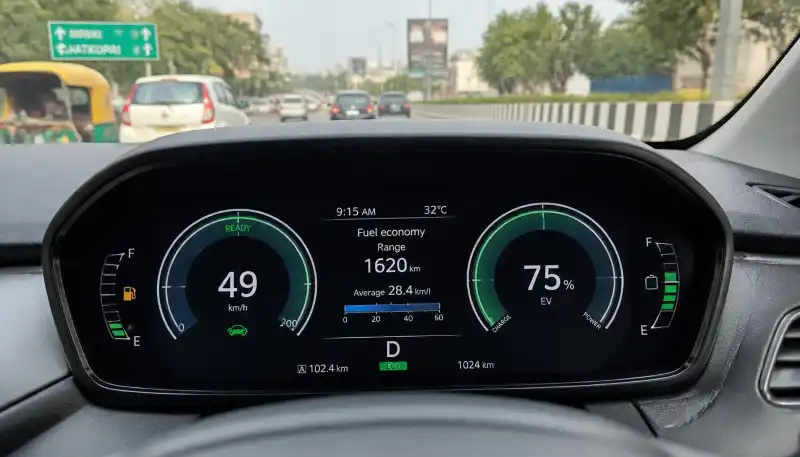
For a real-world look at how the newer battery platforms handle longer interstate trips without running into range anxiety, our Tata Harrier EV review and real-world range analysis offer a solid point of comparison.
Mid-Size SUVs vs Sub-4-Metre Crossovers: Why People Moved Up
The sub-4-metre compact crossover segment was on fire between 2020 and 2024. Then prices for fully loaded versions crossed ₹14 lakh, and a lot of smart buyers started looking at the 4.3-metre mid-size category instead.
- Cabin Space and Road Presence: Cars like the Kia Seltos, Hyundai Creta, and Maruti Grand Vitara give you proper rear shoulder room for three passengers, bigger boots, and better high-speed stability on expressways. You can add all the accessories you want to a sub-4-metre car, but it will never match the physical road presence or highway composure of a larger chassis.
- Better Long-Term Value: In the ₹13 to ₹16 lakh budget bracket, picking a mid-spec variant of a mid-size SUV gives you better everyday comfort, wider glass areas, and stronger resale value than maxing out a top-end compact hatchback or micro-crossover.
If you’re hunting for dependable family cars that still feel solid across different budgets, our guide to underrated cars in India breaks down sensible, well-built alternatives.
What’s Coming and a Few Practical Launch Notes
- Mahindra Scorpio Lifestyle Pickup: Built primarily for international export markets where dual-cab utility pickups are treated as normal family runabouts, this model is expected around early 2027. It is designed to sit as a far more affordable, rugged alternative to the Toyota Hilux.
- Skoda Slavia & Kushaq Updates: Skoda is expected to pair the 1.0-litre TSI with an 8-speed torque-converter automatic in future Slavia and Kushaq updates, improving refinement and ease of driving in city traffic.
- Practical EV Commuting: For short daily commutes of about 50 km combined with two or three long highway trips a year, compact electric crossovers like the Tata Punch EV (with a 40 kWh battery pack) it continues to be one of the most practical and value-for-money choices below ₹12 lakh.
Simple Ownership Rules That Save Money
- Match the Engine to Your Actual Mileage: Stick with normal petrol if you stay under 1,000 km a month. Only go for diesel, CNG, or EV if your monthly odometer regularly crosses 1,500 km.
- Service by the Odometer, Not Just the Calendar: If you drive 50 km a day, you will hit the 10,000 km threshold in roughly eight to nine months. Get the car serviced as soon as the distance is reached instead of waiting for a 12-month calendar reminder.
- Skip the Expensive Fuel Hype: High-octane fuel like XP100 is strictly formulated for high-compression sports cars and high-capacity superbikes. In a regular family commuter, it does not add power or boost mileage — it just burns unnecessary money at the fuel pump.