Tata Harrier EV Review: Is It Really Worth Buying?
A quick test drive is useful, but it can also be misleading.
You can drive an EV around a dealership for 20 or 30 minutes, check the acceleration, look at the screens, and go home impressed. The real test starts later. What happens when you are stuck in traffic for an hour? How does the car behave on a rough road? Does the AC cool the cabin properly on a 40-degree afternoon? And what about a 500-km highway trip?
Those are the things that matter when you are spending serious money on a family SUV. If you are comparing segment options before settling on a budget, tracking pre-festive EV discounts across India on larger crossovers is always worth a look.
The Tata Harrier EV certainly has the numbers to attract attention. There are 65 kWh and 75 kWh battery options, while the more powerful version gets two motors and all-wheel drive. It is big, quick, and packed with technology.
But numbers on a specification sheet are only part of the story.
Ride quality is one of its biggest strengths
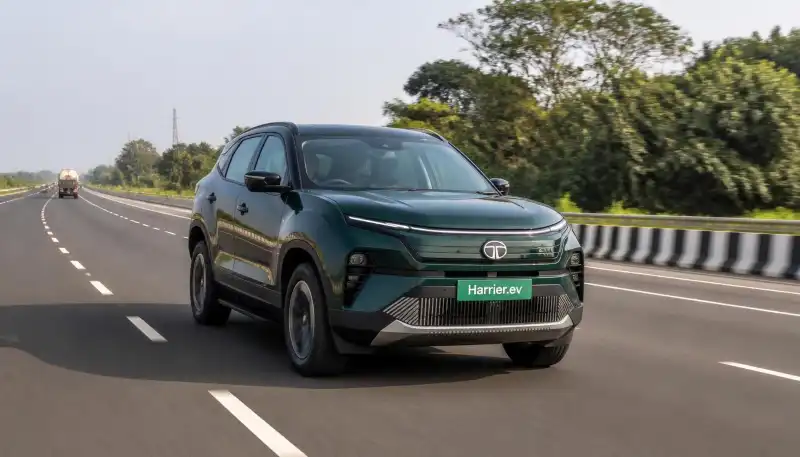
The Harrier EV feels surprisingly easy to drive for such a large SUV.
The electric motor responds the moment you press the accelerator. Even the 235 bhp single-motor version has enough power for normal city and highway driving. Move up to the 390 bhp dual-motor QWD model, and things get much more serious.
You notice that extra performance most when you need to overtake. There is no waiting for a gearbox to find the right gear. Press the pedal, and the car simply moves.
And despite weighing around 2.2 tonnes, it does not feel as heavy as you might expect.
The suspension is another area where Tata seems to have got the balance right. Bad patches, road joints and broken sections of tarmac are handled without making the cabin uncomfortable. On a good highway, the car feels planted too.
That combination of a soft ride and good high-speed stability is probably one of the Harrier EV’s biggest advantages as a family car.
Forget the brochure range for a moment
The official MIDC figures look impressive.
The 65 kWh version is rated for up to 538 km, while the 75 kWh version is claimed to go as far as 627 km.
But don’t expect the car to deliver those figures every time you plug it in.
Real driving is different. You have traffic, passengers, luggage, air conditioning, temperature changes, and, most importantly, your right foot.
For everyday mixed driving, the 75 kWh version can realistically return somewhere around 430–450 km on a full charge. Your result could be higher or lower depending on how and where you drive.
For a person travelling 50–80 km a day, that is plenty.
You could do your weekday commute without thinking about charging every evening. Plug it in at home when necessary and carry on with your routine.
Long-distance driving is a different matter. If you regularly drive 500 or 600 km between cities, you should map out charging points before heading out. Keep an eye on upcoming electric and hybrid cars in India as well, since real-world range capabilities across long-distance SUVs continue to improve with every new rollout.
Charging: good when the infrastructure is good
This is where EV ownership can be either very convenient or slightly frustrating.
At home, it is easy. Install a 7.2 kW wall box, and you can leave the car charging overnight. There is something very convenient about starting the morning with the battery already topped up rather than making a separate trip to a fuel station.
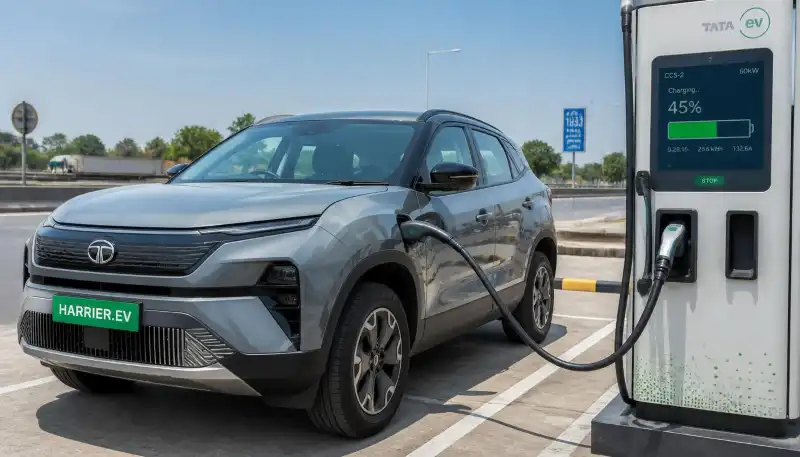
The Harrier EV can also use DC fast charging at up to 120 kW.
Under suitable conditions, Tata quotes around 25 minutes for a 20–80% charge with a sufficiently powerful charger.
That is useful on a long journey. You can stop, take a break, grab something to eat, and get a significant amount of range back.
The problem is not really the car. It is the charger.
On busy routes, a charger may already be occupied. On smaller routes, there may not be one nearby at all. Sometimes you may also come across a charger that is not working as expected.
When taking an EV on a long journey, I’d still plan around charging points instead of depending solely on the remaining-range estimate.
The cabin feels properly spacious.
Inside, the Harrier EV has the sort of cabin space you would expect from a large family SUV.
The seating position is high, and the view ahead is good. There is enough room to make long journeys comfortable, and rear passengers should not feel as if they have been squeezed into the last available space.
The driving position is generally easy to get used to as well.
However, a few small things start bothering you after spending more time in the car.
The wireless charging area isn’t particularly friendly to every large smartphone. Some owners may also miss having a dedicated little storage spot for things such as sunglasses or other small items.
Then there are some of the interior materials. The cabin looks modern, but a few lower-dashboard plastics and bits of switchgear don’t quite have the premium feel you might expect from a ₹25–30 lakh SUV. For buyers looking at strict value-for-money ergonomics across lower segments, exploring underrated compact cars in India can often provide a surprising contrast in cabin packaging.
These aren’t reasons to reject the car. They are simply the sort of details you notice more after the initial excitement wears off.
Lots of technology, but not completely trouble-free
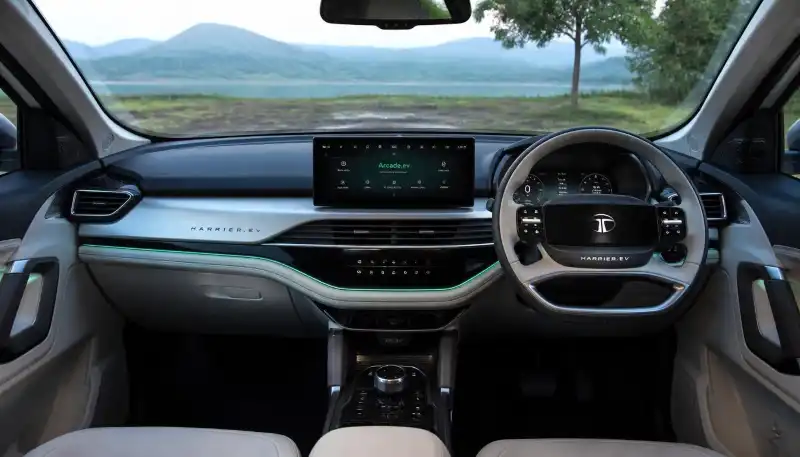
The Harrier EV has plenty going on inside the cabin.
There are high-resolution displays and a 540-degree camera system, among other features. On the equipment front, it certainly doesn’t feel basic.
The software is a little less convincing.
At times, the system can take a moment to respond. The camera display may also need an extra second to appear. Wireless phone connectivity can occasionally be temperamental too.
Tata is addressing software issues through OTA updates, which is encouraging. Still, buyers should be prepared for the occasional small glitch.
Personally, this is why I would spend more time playing with the infotainment system during a test drive instead of just checking whether a feature is present on the specification sheet.
Having 20 features is not much use if two of them are unreliable when you actually need them.
What happens to the AC in peak summer?
This deserves a proper test in India.
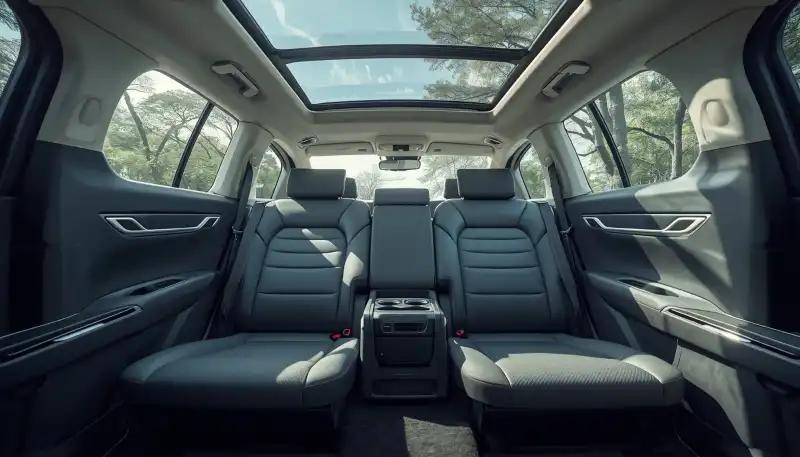
The Harrier EV has a large cabin and plenty of glass. On a very hot afternoon, there is a lot of heat to remove before everyone inside starts feeling comfortable.
The AC will obviously use more energy when it is working hard, and that can have an effect on range.
If the car has been parked outside in direct sunlight, give the cooling system some time. Don’t judge it after two minutes.
If I were buying one, I would specifically ask for an extended test drive in the afternoon during hot weather. Sit in the rear seats as well. Check whether the airflow actually reaches the people sitting there and whether the cabin stays comfortable once the initial cooling is done.
That’s far more revealing than anything you’ll find in a brochure.
Don’t forget about the tyres
Running an EV is not completely free of wear-related costs.
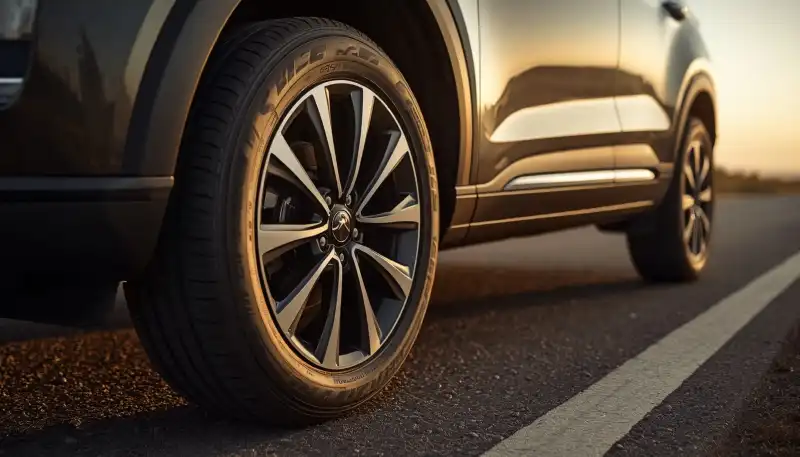
The Harrier EV is heavy, while its electric motors provide an immediate surge of torque. If you enjoy hard acceleration frequently, the tyres are going to notice it.
Of course, tyre life depends on several things. Driving style, road quality, wheel alignment, tyre pressure, and the tyres themselves all matter.
So don’t assume that because the car is electric, every running cost will automatically be lower.
When calculating the ownership cost, keep some money aside for wheel alignment, tyre rotation, and eventually a new set of tyres. Insurance and routine maintenance also need to be included in the calculation.
Who is the Harrier EV actually for?
This is probably the most important question.
If you have a charger at home or at work, the Harrier EV becomes much easier to live with.
It makes sense for someone who spends most of the week driving around town and occasionally heads out on a planned highway trip. You get the quietness of an EV, instant acceleration, and a comfortable ride without having to visit a petrol pump.
It also suits people who like the feeling of driving a large SUV but want an electric powertrain.
I would think twice if:
- You regularly drive 600 km or more in a single day.
- Your routes take you through places with limited fast-charging facilities.
- You don’t have access to home charging.
- You don’t want to plan charging stops on long journeys.
- You are particularly sensitive to tyre replacement costs.
My take on the Harrier EV
The Harrier EV has a lot going for it.
The ride is comfortable, the performance is strong, and the cabin has the space that most family-SUV buyers are looking for. The 75 kWh battery also gives it a useful real-world range, assuming your driving conditions are reasonably favourable.
But I wouldn’t buy it purely because the brochure says 627 km.
With dependable charging, predictable day-to-day use, and a willingness to plan longer journeys around charging points, I’d be comfortable buying it.
There are still a few rough edges. The car is heavy, the software isn’t perfect, and public charging can be the weak link on some routes. The AC also deserves a proper summer test before you hand over your money.
For the right owner, though, the Harrier EV can be a very convincing family SUV.
The simple rule is this: if you can charge at home and most of your driving is within a sensible daily range, the Harrier EV makes a lot of sense. If you spend every weekend covering hundreds of kilometres on unpredictable routes, a conventional petrol or diesel SUV may still be easier to live with.
Quick FAQs
What range can I expect from the Harrier EV? For the 75 kWh version, around 430–450 km in mixed everyday driving is a reasonable expectation. Actual range will change with speed, traffic, weather, passengers, and AC use.
How long does fast charging take? With a suitable 120 kW DC charger, Tata quotes around 25 minutes for a 20–80% charge under the right conditions.
Is there an all-wheel-drive Harrier EV? Yes. The 75 kWh version is available with a dual-motor QWD setup producing 390 bhp.
Is it good for daily city use? Yes. In fact, this is where the Harrier EV makes the most sense. If your daily driving is around 50–80 km and you have home charging, you should not need to worry about charging every day.