Tata Nexon EV vs Kia Syros EV: Which ₹15–17 Lakh Electric Crossover Actually Makes Sense?
A couple of years ago, picking an electric SUV in the ₹15–17 lakh bracket was easy. Most buyers just went for the Nexon EV if they needed something practical for family duty. If you’re exploring the wider market, there are plenty of pre-festive EV discounts across India on models like the Curvv and ZS EV right now.
That’s changed.
Kia’s Syros EV has shown up with a taller body, more rear space and a choice of two batteries. The decision now feels more open, especially if passenger comfort matters to you.
I’m looking at the Tata Nexon EV 45 against the Kia Syros EV 42 kWh. On-road prices move around depending on city and exact trim, so take the numbers as a guide.
Size – what the tape measure doesn’t show
Both cars are 3,995 mm long. From the outside, they look roughly the same size.
Sit inside, and the difference is obvious.
The Syros stands 1,670 mm tall with a 2,550 mm wheelbase. The Nexon is 1,625 mm tall and uses a 2,498 mm wheelbase. Kia has clearly put that extra height and length into making the cabin feel bigger.
You feel it most in the rear. Headroom is good, and the bench can slide and recline on the right variants. You can give passengers more legroom or free up a bit of boot space when needed.
The Nexon is perfectly usable in the back. It just doesn’t feel as open. If four adults will travel together regularly, do a proper rear-seat test in the Syros before you decide.
Boot space
Tata quotes 350 litres for the Nexon EV.
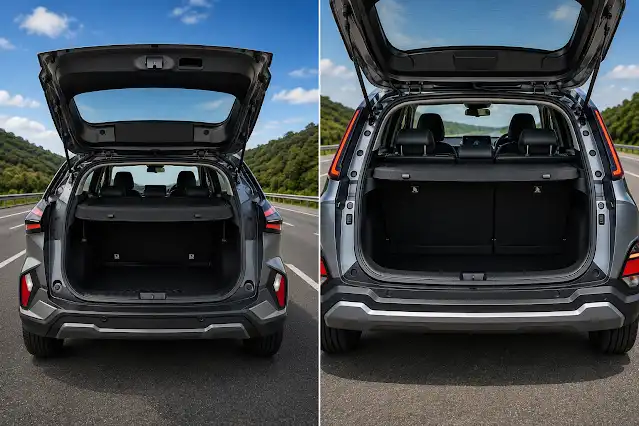
Kia lists 390 litres for the Syros in normal form, and up to 465 litres if you slide the rear seats forward.
That flexibility helps. A couple of suitcases, shopping bags and a school bag can fill a compact boot quicker than you expect. Being able to reclaim space when the rear seats aren’t fully occupied is useful for family running.
On pure practicality, the Syros has the edge.
Looks
This is purely personal taste.
The Nexon EV keeps the familiar rounded Tata SUV shape and the lighting style the brand uses on its newer models. It looks compact and conventional.
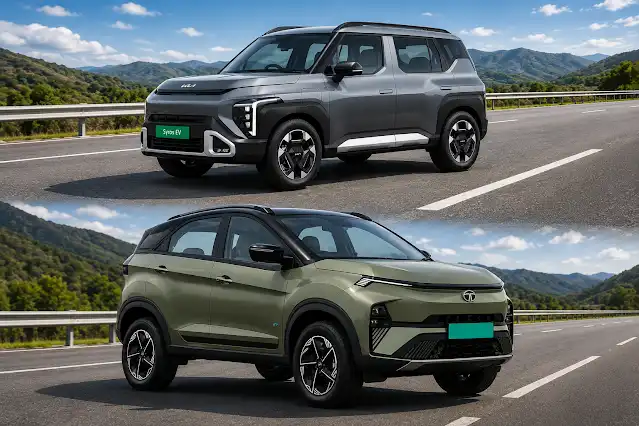
The Syros is taller and more upright with a large glass area. The higher driving position gives a clear view of the road and what’s around you.
Neither is better or worse. If you prefer a traditional compact SUV look, the Nexon will feel more familiar. If you like the tall-cabin style, the Syros makes more sense.
Battery and range
This is the biggest difference between the two.
The Nexon EV 45 has a 45 kWh battery. Tata rates it at 106 kW and 215 Nm, with an official ARAI MIDC range of 489 km.
The Syros EV 42 uses a 42 kWh pack. Kia quotes 99 kW (about 135 PS) and a certified MIDC range of 443 km.
So any older claims of “350–400 km official” for the 42 kWh Syros are simply wrong. The official figure is 443 km.

Real-world range is never the same as the certified number. Speed, traffic, temperature, air-con use, and how hard you drive all change the outcome. A long high-speed highway run will cut range faster than calm city driving.
On paper, the Nexon has the higher certified range. If your daily distance is only 30–50 km, the gap may not matter much in practice.
Performance
The Nexon has the stronger motor.
106 kW and 215 Nm give it decent punch in city traffic and quicker responses when you need to pull out or overtake. Tata claims 0–100 km/h in 8.9 seconds.
The 42 kWh Syros makes 99 kW and 135 PS. It’s not slow, but I wouldn’t buy it expecting it to feel faster than the Nexon.
Kia has clearly prioritised space and comfort over outright performance in this version. Both cars have enough power for normal city driving. On a busy road, the Nexon’s extra output helps more when you need a clean overtake.
For buyers who are not strictly tied to an electric powertrain and want the best cabin value for money, exploring underrated compact cars in India like the XUV 3XO can also be a sensible move before finalising a budget.
Features
The Nexon EV Empowered 45 has a few items that are actually useful day-to-day.
The 360-degree camera is one of them. It makes parking in tight market lanes or crowded apartment basements much less stressful. This trim also gets a blind-spot view monitor, front parking sensors, voice-assisted electric sunroof, cruise control, and wireless charging.
The Syros goes a different way. On the 42 kWh HTX, you get a large panoramic display, panoramic sunroof, sliding and reclining rear seats, and power windows for all four doors.
For me, the rear-seat setup is the biggest everyday advantage. If people spend a lot of time in the back, that practicality matters more than another screen.
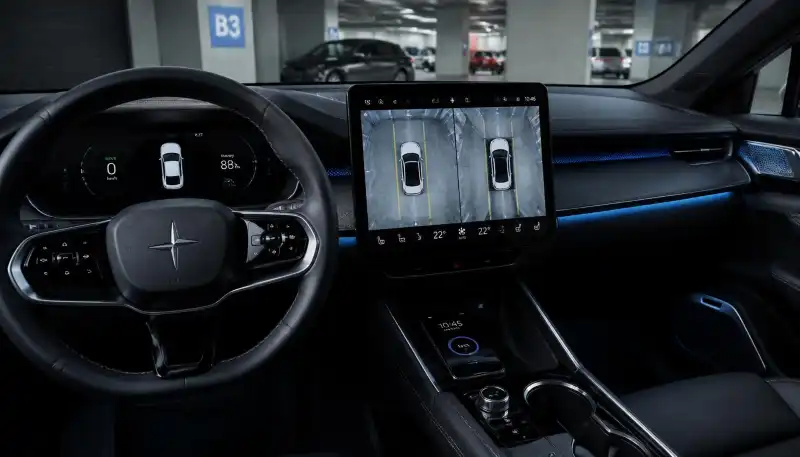
Camera clarification
This needs to be clear because the variants get mixed up easily.
The Syros EV HTX 42 does not get a 360-degree camera. Kia keeps that feature (and the Blind View Monitor) for the higher X-Line ER.
In a straight Empowered 45 versus HTX 42 comparison, the Nexon has the advantage in camera coverage.
Safety
The Nexon EV carries a 5-star Bharat NCAP rating. The Empowered 45 also includes the 360-degree camera and blind-spot view monitor.
Safety is enhanced with six airbags offered as standard on the Syros EV. Higher trims add more advanced equipment, including Level 2 ADAS.
Variant choice matters here. A car can look cheaper on paper, but if you want specific safety features, you may need to step up a trim or two.
Charging and ownership
This is the part many buyers should think about first.
If you can charge at home or at work, both cars become much easier to live with. If you rely only on public chargers, the location and reliability of those chargers can matter more than a 40–50 km difference in claimed range.
Tata says the Nexon EV can go from 10–80% in around 40 minutes on a 60 kW DC charger.
Kia claims roughly 39 minutes for 10–80% on a 100 kW DC charger for the Extended Range version (times vary with conditions). For the 42 kWh Syros, AC charging from 10–100% is listed at around four hours on an 11 kW charger.
Both brands offer strong battery warranties (lifetime high-voltage cover under their own terms for first owners).
Which one makes more sense?
Neither car completely beats the other.
The Nexon EV 45 is the more complete package overall. You get the larger battery, stronger motor, higher certified range, and useful equipment like the 360-degree camera. Tata also has longer experience selling EVs in India.
The Syros EV 42 becomes interesting when cabin space and passenger comfort are the priority. The taller body, longer wheelbase, sliding/reclining rear seats and larger boot make a real difference if adults regularly sit in the back.
The bigger Syros battery
There’s another option that changes the picture.
Kia also sells a 51.4 kWh Extended Range version with a certified 526 km MIDC range and 126 kW (171 PS). It costs more, but it turns the Syros into a much stronger long-distance car.
If your budget is firmly in the ₹15–17 lakh zone, stick to comparing the 42 kWh Syros with the Nexon 45. If you can stretch beyond the ₹17 lakh mark, the 51.4 kWh Syros deserves its own look alongside several upcoming electric and hybrid cars in India scheduled to launch this festive season.
My take
For mostly city use, I’d pick the Nexon EV 45. It gives a stronger mix of range, performance and practical equipment. The 360-degree camera is something I’d actually use often.
If the car will regularly carry adults in the rear, I’d spend more time with the Syros EV. That extra rear space is something you notice every day, not just during a short test drive.
Simple verdict
– Nexon EV 45 → better overall package
– Syros EV 42 → better if cabin space and family comfort come first
– 51.4 kWh Syros → worth considering if long-distance driving is a regular part of your routine
Quick FAQs
Official range of the Nexon EV 45?
ARAI-certified MIDC figure is 489 km. Real-world range will be lower and varies with conditions.
Official range of the Syros EV 42?
443 km WLTP for the 42 kWh version. The 51.4 kWh Extended Range is rated at 526 km.
Which has more rear-seat space?
The Syros, thanks to its 2,550 mm wheelbase, taller body, and sliding/reclining rear seats on the relevant trims.
Which has the larger boot?
Nexon EV: 350 litres. Syros EV: 390 litres standard, up to 465 litres depending on seat position.
Does the Syros EV HTX 42 have a 360-degree camera?
No. That feature is listed on the higher X-Line ER.
Which is better for highway driving?
On paper, the Nexon EV 45 has a stronger motor and higher certified range. Actual results depend heavily on speed, traffic, weather, and air-conditioning use.
Which should a family buy?
If rear-seat comfort and flexibility matter most, look closely at the Syros. If you want stronger performance, higher certified range, and a 360-degree camera, the Nexon EV 45 is the better fit.