Hyundai Bayon India Launch: Price, Engine and Size Reality

Let us be completely honest. Walking into a modern car showroom feels overwhelming because buyers get caught right in the middle. You sit inside an entry crossover like the Venue, and the rear bench feels tight for a growing family. Step towards the Creta, and on-road quotes blow past twenty lakh before you even talk about accessories.
Hyundai knows this gap inside out.
To plug that hole, the Korean maker has officially confirmed the Hyundai Bayon India launch for 26 October 2026. Dealership bookings have already opened across the country with a token amount of ₹11,000. Instead of rolling out another compact hatchback on stilts, they are playing a smart size game. Stretching close to 4.2 metres, it lands cleanly between sub-compacts and full mid-size crossovers.
Does an in-between family motor actually make financial sense for daily use? Let’s take a closer look at what’s included.
The Platform, Safety and Global Crash History
Underneath the metal skin, the Bayon uses Hyundai’s proven K-platform. That is proper peace of mind for anyone refusing to take chances with family road safety.
Cars built on this architecture have regularly picked up solid crash test marks. The body shell uses plenty of high-tensile steel to route brutal impact forces around the passenger cell. Hyundai aims for top safety marks here, backing things up with six standard airbags, electronic stability control, and Level-2 radar camera driver assistance on top trims.
Before putting any hard token cash down on an upcoming launch, spend five minutes reading our practical first-time car buyer guide in India to sort your true monthly ownership budget.
4.2 Metres Long: How Big Does It Look on the Road?

Because this motor extends past the four-metre line, it does not get the small-car GST tax break. Even so, it never feels clumsy or awkward to squeeze into tight apartment parking slots.
Parked on the street, its overall footprint looks remarkably similar to a Skoda Kushaq or Volkswagen Taigun. It gets an upright stance, with chunky roof rails adding extra visual height.
Up front, sharp connected LED daytime running lights run across the nose, with low-set projector lamps handling dark roads. The side profile gets rugged black cladding around the wheel arches, framing sixteen- and seventeen-inch diamond-cut alloy wheels.
Tucked neatly under the nose is a 360-degree camera alongside a front radar sensor for Level-2 ADAS. Hyundai has loaded it with 12 parking sensors in total (six up front and six at the rear), plus all-four disc brakes on top trims.
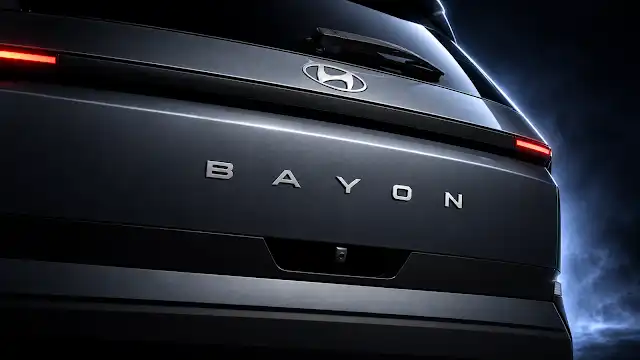
Round the back, distinct arrow-styled LED tail lamps spread across the tailgate. The extended rear gives you a generously deep boot that easily swallows large family suitcases and airport bags without drama.
Lifting the boot floor reveals a dedicated R15 steel spare wheel. While it is two sizes down from the 17-inch road alloys, having a proper spare wheel rather than just a puncture repair kit gives essential peace of mind on long highway stretches. You also get a 60:40 rear-seat split, parcel tray, and a boot-mounted Bose subwoofer.
Whenever you head over to a showroom to inspect a fresh crossover before registration, keep our practical electric car PDI checklist open on your phone to check body panels, glass, and electrical fittings.
Cabin Tech, AI Features and Interior Comfort
Step inside, and Hyundai has loaded the dashboard with kit that avoids feeling like hollow showroom gimmicks.
The dashboard layout carries driver-centric twin 12.3-inch curved screens running fresh software integrated with Perplexity AI and Sound Hound voice controls, backed by Nvidia cloud navigation. Instead of shouting stiff robotic commands to change the blower speed, you can talk naturally to adjust cabin cooling or plan quick highway stops.
A few thoughtful touches make everyday commuting far easier:
The cabin gets an all-black theme with contrast red stitching. The outboard air vents feature a quirky vertical design that genuinely looks like a soda can slotted into the dashboard. You get an 8-way powered driver seat, front-row seat ventilation, a factory-fitted dashcam, and capacitive touch climate controls paired with rotary fan dials. Sound is handled by a premium Bose audio system with front tweeters. The longer wheelbase gives full-grown adults genuine knee clearance in the second row. You also get a wide panoramic glass roof, ambient lighting, fast wireless phone charging, and dedicated rear air-con vents.
In the Cabin: Real-World Wins and Annoying Misses
Engine and Gearbox: Proven 1.5L Petrol Simplicity

Rather than pushing temperamental turbo petrol units straight away, Hyundai is sticking to trusted mechanicals.
Power comes from the familiar 1.5-litre four-cylinder naturally aspirated petrol engine, pushing out roughly 115 PS of power and 144 Nm of torque.
This is the exact same quiet engine doing duty in thousands of Cretas across India. It behaves smoothly, sips fuel sensibly, and skips sudden turbo surges. In slow city jams, the chain-driven IVT automatic takes the work out of stop-and-go driving, while manual drivers get a slick six-speed gearbox.
Popping the hood reveals that Hyundai has skipped an under-bonnet insulation blanket, though the naturally aspirated four-cylinder runs refined enough at regular city speeds.
If you drive beyond 50 km daily and wonder whether fuel bills will bite, punch your commute distance into our EV vs Petrol Savings Calculator to see if going electric makes better financial sense.
Despite widespread rumours of a factory-fitted dual-cylinder CNG setup, Hyundai has confirmed that the Bayon will strictly arrive as a petrol-only offering at launch, skipping CNG entirely.
Expected Pricing and Verdict
Showroom pricing is widely expected to kick off anywhere between 9 and 10 lakh rupees ex-showroom for the base variants. If you want the top-spec model loaded with panoramic glass and ADAS tech, expect on-road numbers to hover near sixteen or seventeen lakh.
By keeping the opening sticker between nine and ten lakh, Hyundai gives buyers a genuine stepping stone between top-end hatchbacks and expensive SUVs. If you want family cabin space, modern safety tech, and trusted petrol reliability without blowing twenty lakh on a Creta, waiting for the Bayon makes total sense.
Quick Answers: Hyundai Bayon
Update: Hyundai has confirmed the dual-cylinder Hyundai Bayon CNG for January with usable boot space.