Home EV Charging in India: A Complete Guide to Wiring, Earthing, Load & Charging Costs
Getting an electric car at home is the exciting part. The less exciting part starts when you look at the parking area and realise that the car needs its own charging arrangement.
For occasional highway trips, public fast chargers are extremely useful. For everyday use, however, most EV owners will find themselves charging at home. The usual routine is simple: come back in the evening, plug the car in and let it charge while the car sits unused overnight.
There is one thing worth remembering here. An EV charger is not just another wall socket. The car can draw a substantial amount of current for several hours, so the cable, earthing, protection equipment and available electrical load all need to be suitable. If you are exploring how different electric models fit into everyday budgets, you can check our electric car range and battery buying guide before finalising your setup.
A little planning before installation can save you from overheating wires, repeated MCB trips, and expensive electrical work later.
3.3 kW Portable Charger or 7.2 kW Wall box?
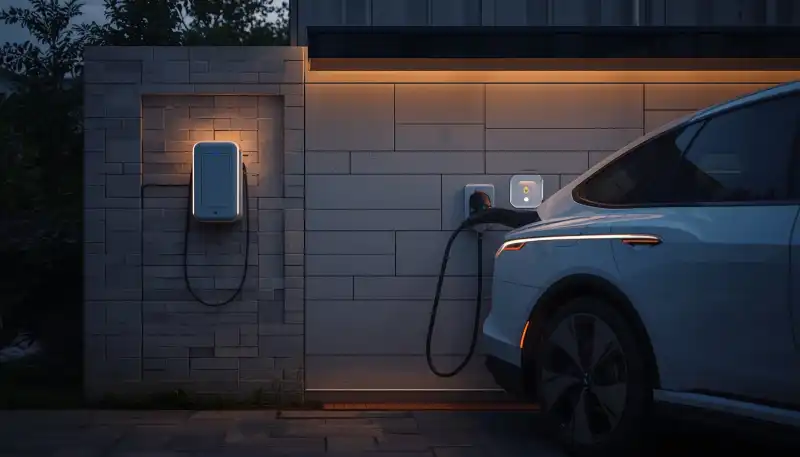
For home charging, Indian EV owners generally come across two options: a portable AC charger and a fixed wall box.
The charging speed isn’t decided by the charger box alone. Your car’s onboard AC charger also has a limit. So before spending money on a more powerful wall box, check what your particular EV can actually accept.
3.3 kW Portable Charger
The portable charger is convenient because you can keep it in the boot and take it with you. When used at home, it should be connected to a properly rated 16A socket and a suitable dedicated circuit.
With a battery in the 30–40 kWh range, a full charge can take somewhere around 10 to 14 hours. Actual time varies with the vehicle and charging conditions.
That sounds slow, but it isn’t necessarily a problem for someone who drives 25–40 km a day. If you get home in the evening with plenty of battery remaining, plugging in overnight can easily replace the energy used during the day’s commute.
It also has another advantage. You can carry the portable unit when travelling and use a suitable electrical connection at a hotel, relative’s house, or another destination if you need an emergency top-up.
The obvious trade-off is charging speed. If you arrive home almost empty and need to leave again after three or four hours, a 3.3 kW setup may not add enough range in that short window.
7.2 kW AC Wall box
A wall box is the more convenient choice for owners who drive longer distances or want the car ready sooner.
It stays permanently mounted near the parking space and is connected through a dedicated electrical circuit. Depending on the vehicle and the home’s electrical supply, the installation may be single-phase or three-phase.
A 7.2 kW charger can reduce charging time considerably compared with a 3.3 kW unit, but don’t assume that every house can simply support one. Your sanctioned load, existing wiring, and the car’s onboard charger all matter.
If you regularly cover 70–100 km or more a day, have more than one EV at home, or simply don’t want to wait as long for a recharge, the wall box is usually the more practical arrangement.
Don’t Use Ordinary Household Wiring for the EV Circuit
Think twice before saving a few hundred rupees now—you could pay far more for it later.
Lighting circuits commonly use relatively thin household wires because lights and small appliances don’t continuously draw the kind of load an EV charger can place on a circuit.
Always use a dedicated cable for the charger and choose the correct size for the setup. Key factors include the charger’s current rating, cable length, installation conditions, ambient temperature, and acceptable voltage drop.
- For a typical 3.3 kW installation, 4 sq. mm copper cable is commonly used, while a 7.2 kW setup may require 6 sq. mm or larger.
- Longer cable runs can require a larger size to keep voltage drop under control.
- For outdoor cable runs, mechanical protection is equally important. A cable crossing a driveway can be damaged by vehicles, tools, or other activity. In such locations, suitable armoured cable or properly installed heavy-duty conduit can provide additional protection.
Use good-quality multi-strand copper cable with suitable insulation. Flame Retardant (FR) or Flame Retardant Low Smoke (FRLS) rated insulation is recommended depending on the installation route.
And avoid the common shortcut of asking an electrician to use leftover household wire simply because it is already lying around.
Earthing: The Part You Shouldn’t Ignore

A good earth connection is particularly important for EV charging.
Before charging begins, the vehicle and charging equipment check the electrical connection, including the protective earth. If the earth connection isn’t within the charger’s acceptable range, charging may refuse to start, or the system may display an earth-related fault.
That is why the existing earthing should be tested, rather than simply assumed to be adequate.
Some installers recommend a dedicated chemical earthing system using a copper-bonded electrode and conductive backfill compound. This can be useful where the existing arrangement doesn’t meet the required performance, but there isn’t one earthing design that automatically suits every Indian house.
The right approach is to follow the charger’s installation requirements and applicable electrical standards, then verify the installation with an earth-resistance test. What matters is whether the completed installation actually provides the required electrical performance.
Give the Charger Its Own Protection
Your EV charging circuit should ideally be separate from heavy household appliances.
A small dedicated distribution board near the parking area can make the circuit easier to isolate and maintain. The exact protection equipment depends on the charger and the electrical installation, but commonly includes the following:
- MCB (Miniature Circuit Breaker): This protects the circuit against excessive current and short circuits. The breaker rating should be selected according to the charger’s requirements and cable capacity. A bigger MCB isn’t automatically better.
- RCCB or RCBO: This provides protection against residual-current leakage. The required type and specification should match the charging equipment and manufacturer’s instructions.
- Surge Protection Device (SPD): An SPD can provide additional protection against transient voltage surges. It is particularly useful for protecting sensitive electronic equipment in areas where thunderstorms, lightning, or supply disturbances are a concern.
Never use a higher-rated breaker just because the existing one keeps tripping. That warning should be taken seriously—find out what’s causing the trips first.
Never Use a Cheap Extension Board
This deserves special attention.
Just because the plug fits doesn’t mean the extension board is safe. Always use the proper EV charging connection.
An EV charger may draw substantial current continuously for hours. A poor-quality extension cable, loose socket, or undersized wiring can heat up rapidly and create a serious fire hazard.
The safest approach is a properly installed charging point connected directly to the appropriate circuit with industrial-grade switchgear.
Check Your Sanctioned Load Before Buying a 7.2 kW Charger.
This is an easy detail to overlook.
Picture a typical summer evening. The air conditioners are running, the refrigerator is on, someone switches on the water heater, and perhaps the washing machine or water pump is operating too. Now add a 7.2 kW EV charger.
The home’s total demand can rise very quickly.
If the electricity connection has a limited sanctioned load, it may not comfortably cope with the combined demand of the appliances and the EV charger. Depending on the circumstances and local DISCOM rules, an overloaded connection can result in repeated tripping or the need for a sanctioned-load upgrade.
Look at your latest electricity bill and check the sanctioned load before finalising the charger.
If it isn’t enough, contact your electricity distribution company about increasing the load. You can also read our electric vehicle maintenance and safety tips to keep your running costs transparent and predictable.
Home EV Charging Costs: What You Need to Know
This is where the difference between kW and kWh becomes important.
The charger’s kW rating tells you how quickly it can deliver electricity. Your electricity bill, on the other hand, is based on the number of units of electricity consumed, measured in kWh.
Take a simple example. Suppose an EV has a usable battery capacity of around 40 kWh. The electricity coming from the grid can be slightly higher because some energy is lost during charging.
If the car uses approximately 42 units from the meter for a full charge and your effective electricity rate is ₹7.50 per unit:
- Total energy cost:
42 units × ₹7.50 = ₹315 - If those 42 units give the car around 280 km in real-world driving:
\text{Running Cost} = \frac{₹315}{280} \approx ₹1.13\text{ per km}
These are example figures rather than a guarantee. Your actual cost will depend on the electricity tariff, battery size, charging losses, driving conditions, traffic, air-conditioning use, and the range your car achieves.
What If You Live in an Apartment?
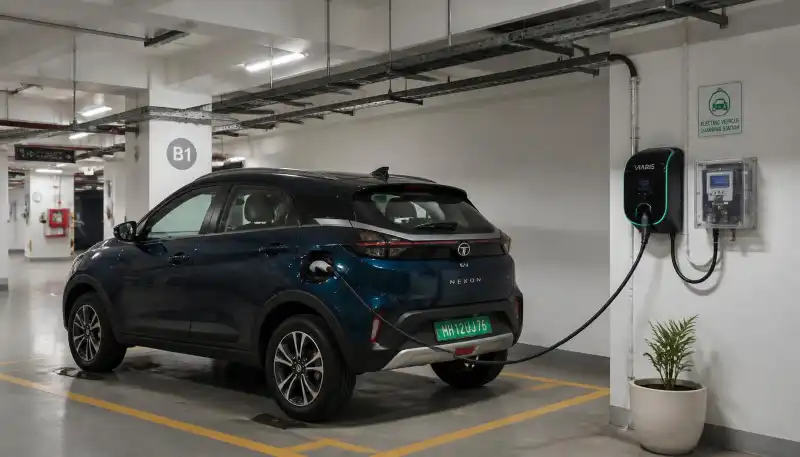
Charging an EV in an independent house is usually straightforward. Apartment parking needs a little more coordination.
Before installing anything in a society, speak to the RWA or building management. Give them the charger specifications and explain exactly where the parking space is located and how you intend to route the cable.
The society may have rules covering common electrical areas, cable routing, fire safety, and access to the meter room.
Ideally, the electricity consumed by your car should be separately measured. A dedicated sub-meter or another approved metering arrangement can make the billing transparent and avoid disputes over who has consumed how many units.
If your flat’s electricity meter is several floors away from the parking area, the building management may also need to approve the route. What you shouldn’t do is run an unprotected cable across a common driveway or staircase simply because it is the easiest route.
Everyday Charging Habits That Make Sense
You don’t necessarily have to charge an EV to 100% every single night.
For daily commuting, many owners use a lower charging limit (such as 80%) and keep the battery full when they know a longer journey is coming up. The best charging routine depends on the battery type and the maker’s advice.
If your electricity provider has a Time-of-Day tariff, scheduled charging can also reduce running costs. Instead of starting the charging session immediately after reaching home, you can set the car or charger to begin during the cheaper night period.
Outdoor installations need another bit of attention. If the charger is mounted in an open driveway, make sure the charger, isolator, distribution equipment, and cable connections have the required weather protection (such as IP65 enclosures).
Frequently Asked Questions
Can I charge an EV using a normal 3-pin plug?
A regular 5A or 6A household socket isn’t suitable for prolonged EV charging. If the portable charger supplied with your car is meant for a 16A connection, have a suitable socket installed with the right cable, circuit protection, and earthing.
Is outdoor EV charging safe during the monsoon?
Outdoor charging is fine, but only with equipment rated for outdoor use. Keep the charger, isolator, and electrical connections properly protected from rain and moisture.
Can I leave my EV plugged in overnight?
Yes, that’s a normal way to charge an EV. The car manages the charging process and stops taking power once it reaches the battery limit you’ve set. Use a properly installed charging point. Avoid extension boards and overloaded sockets.
The Bottom Line
For most owners, home charging is quite straightforward once the electrical side has been planned properly.
If you don’t drive much and the car has the whole night to charge, a 3.3 kW portable unit can do the job. Someone covering long distances every day may find a 7.2 kW wall box more convenient because it can put considerably more energy into the battery during the same overnight period.
Before getting the charger installed, look at the home’s sanctioned load, cable size, earthing, and circuit protection. In an apartment, also sort out the cable route and electricity metering with the society beforehand.
Don’t choose the cheapest option. Pay for good wiring, proper safety protection, and a professional charging point installation.