Bajaj Pulsar N160 SS Review: Has the Old Pulsar Aggression Finally Returned?
I still remember growing up when the Pulsar badge pretty much meant “sporty street bike” on Indian roads. Almost every young rider either wanted one or spent weekends thrashing one on the local bypass. Over the last couple of years, though, the 160cc streetfighter space started playing it a bit too safe. Bajaj has now tried to shake that up with the Bajaj Pulsar N160 SS.
The “SS” stands for Super Sports, and this isn’t just a sticker job or a new colour scheme. It’s a proper attempt to bring back the raw top-end aggression that older Pulsar fans used to love.
Design and Everyday Usability
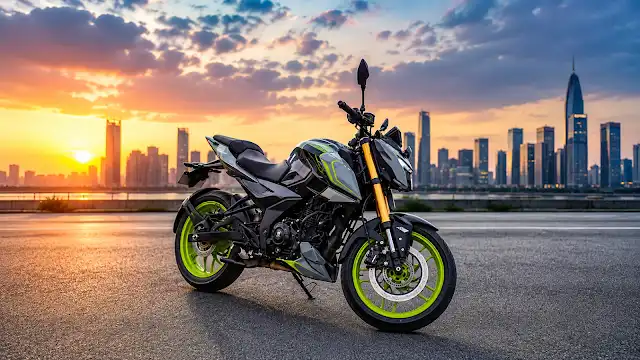
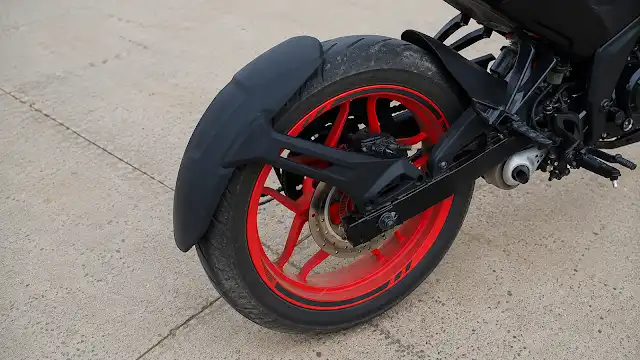
From a distance, the bike still looks familiar — same projector headlamp and sharp LED DRLs. At first glance, it looks the same. At first glance, it may seem the same—but look closer, and you’ll notice the difference. Red accents on the alloy wheels, black-chrome Pulsar badges with red outlines, and sharper tank graphics. At the back there’s a wider 130-section tyre and split grab handles finished in red.
The tech package on the Bajaj Pulsar N160 SS is clearly a step up:
- A sharp 5-inch full-colour TFT screen with navigation and phone mirroring
- Good-quality switchgear and adjustable brake and clutch levers on both sides
- A Type-C charging port mounted right on the tank
The riding position has also been improved. Bajaj raised the handlebar by 39 mm and pulled it back by 19 mm. The result is a more upright posture that feels easier on the wrists and lower back in city traffic.
Seat height is 795 mm, so average-height riders around 5’7″ or 5’8″ can plant both feet firmly. Even riders around 5’4″ will find it manageable, though a slightly narrower seat profile would have made it even easier to flat-foot. Ground clearance is a useful 165 mm, which clears tall speed breakers without touching. The only real downside is the 151 kg kerb weight — it feels a bit heavy when you’re slow-speed manoeuvring in parking spots, but it helps the bike stay completely planted once you’re moving at speed.
The 4-Valve Engine Is the Real Story
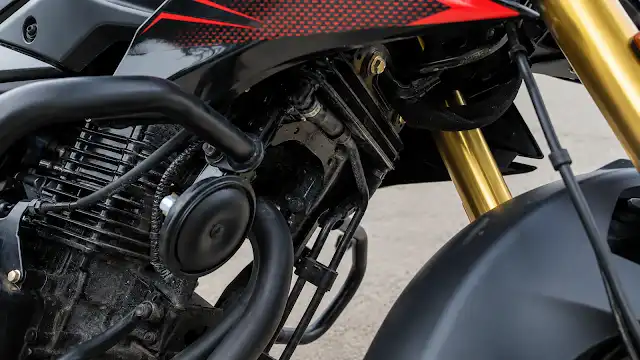
This is where the biggest change sits. The regular N160 uses a 2-valve engine. The SS gets an oversquare, high-compression 4-valve SOHC short-stroke unit with a larger bore and shorter stroke. To handle the extra heat from higher revs, Bajaj added an external oil cooler radiator and internal piston-cooling oil jets.
Peak power is 18.5 PS — currently the strongest naturally aspirated figure in the 160cc class. Torque stands at 14.4 Nm. It also gets ride-by-wire with riding modes and a low-speed glide assist. You can leave the bike in third or fourth gear at crawling city speeds without using the clutch, and the engine manages to keep moving smoothly without stuttering or stalling.
How It Actually Rides
Power delivery has two clear sides. Below 3,500 rpm you’ve already got around 85% of the torque, so you can loaf around in higher gears without the engine complaining. Once you cross 6,000 rpm, the 4-valve head properly wakes up.
Between 7,000 and 9,000 rpm, the bike feels eager and punchy — almost like you’re on something closer to 200cc. Third gear pulls cleanly past 100 km/h and the exhaust note gets noticeably deeper. The lower gear ratios are well-spaced for quick city overtakes, while fourth and fifth gears are kept taller so the engine revs relax when you hit open bypass stretches.
Up front you get 37 mm upside-down forks. At the rear there’s a preload-adjustable mono shock. The front suspension feels a touch firm over sharp bumps, but it stays planted when you tip it into corners.
Braking is handled by a 300 mm front disc and a rear disc with dual-channel ABS. The initial bite is smooth and progressive rather than sharp, which helps keep the bike stable during hard stops on dusty tarmac.
Refinement, Mileage and Price
The engine is surprisingly refined. The clutch action is light, and gear shifts click in smoothly without false neutrals. You can sit at 80–85 km/h on the highway all day without annoying vibrations coming through the pegs or tank. A slight buzz only creeps into the handlebar once you push past 7,500 rpm near the top end.
In mixed city riding, you can expect 50–55 km/l. Ride it hard, explore the top-end revs frequently, and that drops to around 45–48 km/l.
Prices start at roughly ₹1,33,000 and go up to ₹1,42,500 for the top version with the USD forks and full TFT screen. If you only want a calm daily commuter with maximum mileage, the standard 2-valve N160 still makes sense. But if you want that extra performance spark, you’re paying only ₹2,500–3,000 more for the Bajaj Pulsar N160 SS. You get a clear jump in power, better hardware, and dual-channel ABS as standard, which makes it strong value.
Quick FAQs
How is the N160 SS different from the normal N160? It gets the more powerful 4-valve oil-cooled engine (18.5 PS), ride-by-wire, riding modes, adjustable levers, USD forks, and the 5-inch colour TFT display.
What mileage can you expect? Around 50–55 km/l in normal mixed riding. Push it hard past 7,000 rpm, and it’ll settle closer to 45–48 km/l.
Does the aggressive riding position make it less practical for everyday use? No. The raised and pulled-back handlebar makes it quite upright and comfortable for city commuting.
Does it get dual-channel ABS? Yes, dual-channel ABS is standard equipment, complemented by a 300 mm front disc.