Buying a proper seven-seater family car in India has always forced people into uncomfortable compromises. If you wanted low running costs, you usually ended up looking at a Maruti Ertiga or XL6. Honest talk: while those cars are brilliant on fuel, they often carry that lingering commercial cab vibe. People running larger families wanted something that felt properly upmarket inside without the soul-crushing monthly petrol bills.
That explains why the Kia Carens Clavis CNG walkaround is causing such a massive buzz. Seeing a genuine factory-fitted setup straight from the plant instead of questionable aftermarket retrofits is a massive relief. Here is a clear, realistic look at what this seven-seater package actually delivers before the keys hit showrooms.

Engine Power: The Reality of Natural Aspiration on Gas
Under the hood sits a familiar 1.5-litre Naturally Aspirated four-cylinder petrol engine. When running on pure petrol, it delivers a healthy 115 PS of power and 144 Nm of pulling torque.
Once the fuel mode switches over to CNG, those performance numbers drop to 96 PS and 123 Nm of torque.
Straight up, that power drop will make a difference on the road. Moving a full-sized vehicle carrying seven passengers and luggage up a steep highway incline will demand sensible downshifts. You get a standard 6-speed manual gearbox here; there is no automatic option on the table for CNG buyers. For city commutes and relaxed cruising, the motor should be smooth enough, but do not expect rapid overtaking sprints.
With shifting buyer preferences and the noticeable petrol car sales drop in India, switching over to factory-fitted gas setups is becoming the obvious practical move for everyday running.
Dimensions and Real 7-Seater Comfort
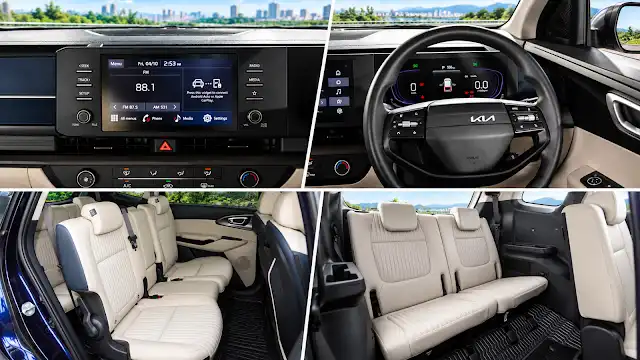
Where this machine completely outclasses sub-4-meter crossovers is its road footprint:
- Length: 4,550 mm
- Width: 1,800 mm
- Height: 1,708 mm
- Wheelbase: 2,780 mm
- Tyres: 205/65 R16 alloy wheels
Because of that expansive 2,780 mm wheelbase, the third row remains one of the most usable seating spaces under ₹20 lakh. Unlike smaller three-row vehicles where adults sit with their knees pinned to their chins, adults can sit in the back here without feeling entirely cramped.
The Boot Space Puzzle: Single 60L Tank vs Luggage
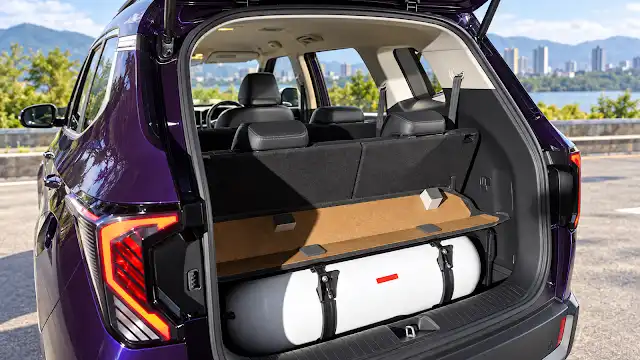
Kia decided against a dual-cylinder under-floor setup, opting instead for a single 60-litre water-capacity CNG cylinder mounted right across the boot floor. The reasoning is clear: splitting the cylinders often pushes the boot floor up, which would compromise the seat-base height and under-thigh support in the third row.
With all seven seats upright, you are left with roughly 100 to 116 litres of usable luggage space behind the tank.
What does that mean for weekend road trips? Large hard-shell trolley bags will not stand upright. You can comfortably slide in a couple of soft duffle bags, small backpacks, or place a slim cabin bag at a slant. For extended family holidays with full passenger capacity, installing a sturdy aftermarket roof carrier will be almost non-negotiable.
Fuel System and Expected Running Economics
The exterior fuel flap neatly integrates both inputs:
- A standard 45-litre petrol tank inlet
- A factory CNG filling nozzle sitting right beside it with official E20 compliance markings
While official ARAI figures are yet to be certified, real-world returns should realistically land between 23 and 26 km/kg in mixed driving conditions. It will not match an Ertiga’ ultra-lightweight frugality due to the Kia’s heavier kerb weight and wider stance, but your per-kilometre fuel expense will easily stay at less than half of what a pure petrol Caren burns through daily.
Expected Price and Variant Position
Base petrol variants of the Carens sit between ₹11.39 lakh and ₹12.86 lakh ex-showroom. Expect the factory-fitted CNG kit to command a standard premium of roughly ₹90,000 to ₹1,00,000 over corresponding petrol variants.
That plants the starting ex-showroom price right around the ₹12.50 lakh mark, translating to an on-road price close to ₹13.80 to ₹14.20 lakh depending on state road taxes.
If your daily routine involves running a busy household, school runs, and weekend family outings where you want modern cabin plastics, crisp screens, and proper road presence without burning ₹10 per kilometre, this factory CNG package bridges a massive gap in the current market.
If you are cross-shopping other spacious family cars in this budget, checking out our guide on the best cars under 15 lakh in India helps put its pricing into clear context.
FAQs for Rank Math (Schema-Friendly)
What engine powers the Kia Carens Clavis CNG?
It runs a 1.5-litre naturally aspirated four-cylinder petrol engine producing 96 PS and 123 Nm of torque in CNG mode, paired with a 6-speed manual transmission.
How big is the CNG tank in the Kia Careens Clavi’s?
It features a single 60-litre water-capacity CNG cylinder mounted behind the third-row seats, alongside a standard 45-litre petrol fuel tank.
How much boot space is left after the CNG cylinder?
With all seven seats raised, there is roughly 100 to 116 litres of usable space remaining, enough for 2–3 soft travel duffle bags or backpacks.
Is an automatic gearbox available with the Carens Clavis CNG?
No, the CNG variant comes paired exclusively with a 6-speed manual gearbox.