Hyundai Bayon CNG India Launch: Dual Cylinder Boot Space Truth
Most people looking into the Hyundai Bayon CNG boot space practicality run into the exact same problem the moment they consider a gas kit. Running petrol in heavy traffic costs serious money every week, but factory gas setups usually steal every bit of luggage capacity with a massive, round steel tank sitting right in the middle of the luggage bay.
Brezza and Fronx CNG owners run into this headache every single weekend. Drop two small travel bags behind the rear bench, and your usable cargo capacity is gone.
That explains the strong interest around the upcoming Hyundai Bayon CNG India launch boot space details. Rather than dropping an off-the-shelf single cylinder right onto the floor carpet, Hyundai worked around the chassis frame so family suitcases still fit. If you are tracking the standard petrol variant, you can also check our breakdown on the Hyundai Bayon India launch details to see how the platform compares.

Twin Cylinders: How Hyundai Matches Tata’s Idea
Tata Motors handled this design hurdle earlier on cars like the Punch and Altroz. They split the traditional 60-litre gas cylinder into two smaller units placed below the false floorboard.
Hyundai uses the identical concept here. The upcoming Bayon variant tucks two smaller capacity tanks under a flush deck lid.
The spare tyre stays right where it belongs. Other brands frequently leave out the emergency wheel completely or hang it underneath where rain and road muck damage the rim. On this car, the spare wheel remains secured in the rear bay, and the flat loading area above takes medium suitcases without trouble. Avoiding practical boot compromises is one of the biggest factors when side-stepping common SUV buying mistakes under 15 lakh in today’s crowded market.
Launch Window: When Does It Hit Showrooms?
The regular petrol Bayon sells from ₹9.99 lakh ex-showroom. Buyers waiting on the factory gas variant will see it shortly.
Engineers are running final homologation and fuel economy trials with the Automotive Research Association of India (ARAI). Once the official test figures come through, dealerships expect customer units in January.
Going by typical market gaps across this segment, the factory gas option should add roughly ₹90,000 to ₹1,00,000 over corresponding petrol manual trims.
Cabin Space: The Real Family Seating Truth

The car looks wide from the kerb, mostly thanks to that 2,600 mm wheelbase on Hyundai’s K platform. Showroom staff might tell you it is broader than a Creta, but daily family life tells another story.
Put two adults on the back bench, and a young child fits fine in the centre. If you try cramming three grown men back there for hours on a hot motorway run, shoulders will definitely clash. That long wheelbase does leave sensible knee clearance behind a tall driver though, and the flat roofline means taller folks will not scrape their heads on bouncy speed humps.
Highway Driving: Radar That Slows Down on Bends
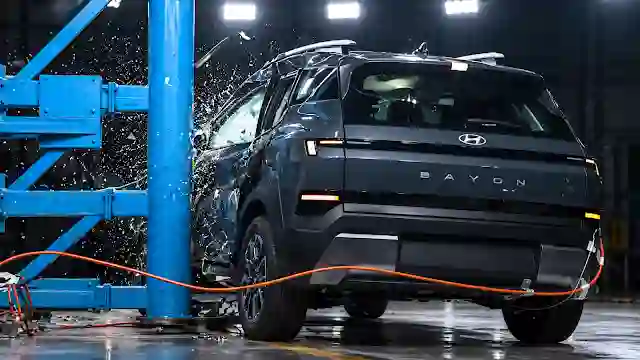
Fast ring roads across India have nasty bends and surprise speed cameras everywhere. To deal with that, the car carries Level 2 Pro ADAS with highway drive assist.
The most practical bit is Navigation-based Smart Cruise Control (NSCC). While basic cruise systems only keep distance from cars ahead, this system reads road maps directly. If a bend comes up too hot, the throttle backs off smoothly on its own until you straighten out. Hit a spot where highway boards drop from 100 to 80 km/h, and it slows the wheels down before a speed trap catches you.
Conversational AI in the Dashboard
Standard car voice prompts get on your nerves. They adjust the fan speed fine, but stumble on real sentences.
The Bayon runs conversational Generative AI instead, answering more like a friend riding as a passenger:
- “Where can we stop for hot tea and clean toilets in the next 15 minutes?”
- “What is worth checking out around our hotel before dinner?”
The factory SIM handles software improvements over the air quietly in the background. Should anyone try fiddling with the vehicle or driving off without asking, you can shut down the engine ignition right from your phone screen instead of calling a garage.
Commuting Costs: Petrol vs Gas Math
Think about running a sixty-kilometre daily office commute:
- Petrol Trim: Typical bumper-to-bumper crawling burns fuel at around 11 to 12.5 km/l. With fuel rates touching three figures a litre, every single kilometre sets you back about ₹8.20. Stack that up over 50,000 kilometres, and you end up handing over four lakh rupees straight to fuel pumps.
- Twin-Cylinder Gas: Mixed daily traffic should easily deliver between 21 and 23 km/kg. At current pump pricing, your cost per kilometre drops under four rupees.
While several buyers are also keeping an eye on upcoming hybrid crossovers for mileage, a twin-cylinder gas kit remains the most cost-effective way to save nearly two lakh rupees over three years without losing luggage capacity.
Frequently Asked Questions
Does this CNG setup ruin boot utility?
Not at all. With the twin cylinders hidden beneath the base board, the boot floor stays open for standard luggage, and the spare tyre sits safely below.
When will the Bayon CNG launch in India?
ARAI mileage testing is wrapping up, and showroom arrivals are lined up for January.
Does it get curve-assist cruise control?