Toyota Urban Cruiser Taisor Review: Affordable Crossover Realities
In this real-world Toyota Taisor review, we break down what this affordable crossover actually offers. Let’s be honest. Car prices in India have shot up over the last few years. So when you walk into a Toyota showroom and see a brand-new badge starting at around seven and a half lakh, it does catch the eye. Climb to the top-spec turbo petrol automatic, and you’re brushing against thirteen lakh. At that point, the value equation starts looking very different.
Most people already know the story. Under the skin, this is basically a Maruti Fronx. Toyota didn’t invent a new platform. They reshaped the front bumper, fitted their honeycomb grille, stuck the Toyota logo on the boot, and backed it with their own dealership and warranty network.
The only question that matters if you’re putting family money on the line is simple: does the Taisor actually work as a daily family car?
Road Presence, Ground Clearance, and Everyday Practicality
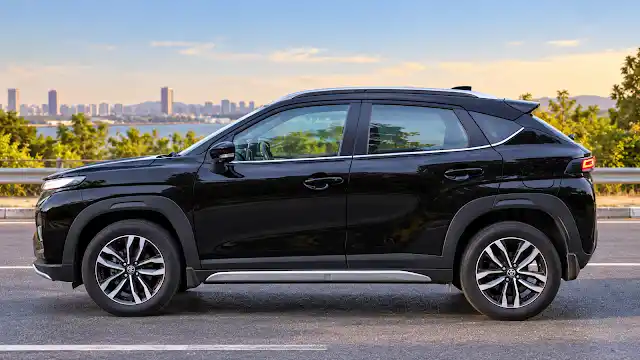
To my eyes, Toyota cleaned up the front end better than Maruti managed with the Fronx. The honeycomb grille sits neatly with the thin dual-line LED daytime running lamps. The triple-element LED headlights lower down throw a genuinely wide beam on dark roads. There are no dedicated fog lamps, but I rarely missed them.
Black cladding runs around the wheel arches and frames the sixteen-inch dual-tone alloys. The real everyday winner on Indian roads is the 190 mm ground clearance. That extra space under the car saves the exhaust and sump from scraping over monsoon potholes and badly built speed breakers. Just remember it’s still a front-wheel-drive city hatchback, not a four-wheel-drive off-roader.
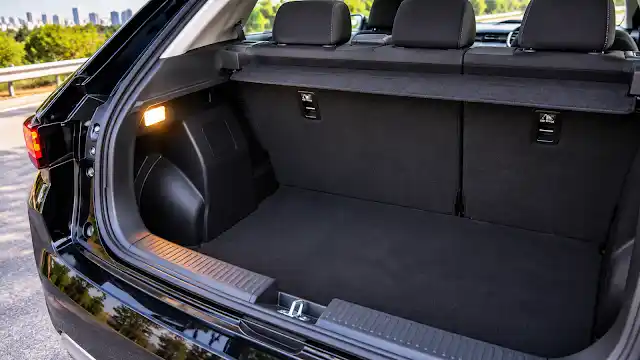
At the rear, a clean LED light strip runs across the tailgate under the Toyota badge. Open the boot, and you get 308 litres. The floor sits quite low, so heavy suitcases need a bit of a lift out. The 60:40 split rear seats fold easily enough for big boxes or flat-pack furniture.
Daily Life Inside the Cabin
Climb in, and the layout feels instantly familiar if you’ve sat in a Baleno, Glanza or Fronx. Dual-tone dashboard, nine-inch touchscreen that runs wireless Android Auto and Apple CarPlay without lag. Keeping the centre console free of charging cables makes the daily commute feel tidier.
A couple of small touches help. The pop-up head-up display sits right in your line of sight and shows speed, so you stop looking down at the dials. There’s also a request button on the passenger door handle – handy when you’re loaded with bags and don’t want to walk all the way round to the driver’s side. Long highway stretches feel relaxed too, thanks to a broad dead pedal and cruise control on the steering wheel.
Rear knee room is better than expected. Two tall adults can sit without their knees jammed into the front seats, and Toyota has added dedicated rear AC vents alongside Type-A and Type-C charging ports.
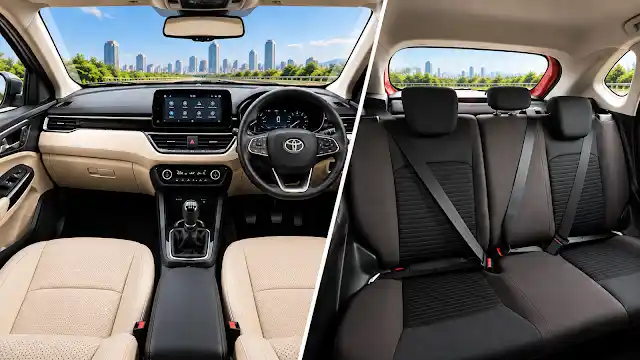
Look closer and the cost-cutting shows. Cabin lights are still dull yellow halogen bulbs. No fold-down centre armrest in the rear, and the back axle sticks with drum brakes. The plastics on the dash also feel lighter compared to Korean crossovers like the Sonet or Venue.
If this is going to be your first family car on a tight budget, spend five minutes reading our first time car buyer guide India, so you know the real monthly numbers.
Engine Choices: 1.2L Normal vs 1.0L Turbo
Toyota offers two petrol engines plus a factory CNG option.
The base 1.2-litre four-cylinder makes 89.7 PS and 113 Nm. If most of your driving is slow city traffic, school runs and local errands, this is the one to take. It’s quiet, sips fuel and is easy to maintain. The AMT takes the strain off your left foot in jams, even if it hesitates a bit on sudden overtakes.
Prefer more punch on the highway? The 1.0-litre three-cylinder Boosterjet turbo changes the character. It delivers 100 PS and 147.6 Nm, matched to a smooth six-speed torque-converter automatic with paddle shifters. Once the revs climb past 2,000, the car pulls cleanly and without drama. You notice a light three-cylinder vibration at idle through the pedals, but it disappears the moment you start moving.
Whenever you go to the stockyard to check your allotted car before registration, keep our practical electric car PDI checklist open on your phone to check body panels, glass, and electricals.
Real-World Fuel Economy
The car is light, so fuel bills stay reasonable.
In heavy city traffic with the air-con on full, the turbo automatic returns about 11–12 km/l. On open roads at steady speeds, it settles between 15 and 16 km/l.
If your daily run is more than 50 km and you’re wondering whether an EV would save more money, run the numbers through our EV vs Petrol Savings Calculator.
Final Verdict: Which Trim Makes Sense?
The smartest buy in the range is still the 1.2-litre naturally aspirated petrol, especially the S or S+ variants. Reliable mechanicals, good ground clearance, and low running costs without stretching the EMI.
The 1.0-litre turbo automatic is more enjoyable on open roads, but spending close to thirteen lakh on a compact crossover puts you uncomfortably near larger mid-size SUVs. If you want Toyota’s dealership support and sensible running costs, stick with the mid-spec 1.2 models.