Royal Enfield Bullet 650 Review: What Has Changed From the Bullet 350?
The Royal Enfield Bullet has been a common sight on Indian roads for decades. People like the old-school look, the solid feel, and the simple presence it has always had. Now the company has moved the Bullet name into a much bigger class with the new Bullet 650.
If you are tracking where the broader market is heading next, our look at upcoming electric and hybrid cars in India puts these new platform launches into perspective.
This bike shares its basic platform and engine with the Classic 650 and Shotgun 650. The Bullet 650 still gets its own look, though. It keeps the traditional Bullet shape, adds more chrome, and uses a proper twin-cylinder engine instead of the single-cylinder one from the 350.
What do you actually get when a Bullet grows from 350 to 650? Is it better for everyday riding? How much power is there? What about the mileage, the weight, and comfort on longer journeys? Let’s have a look.
Classic Bullet Design With a Bigger Engine
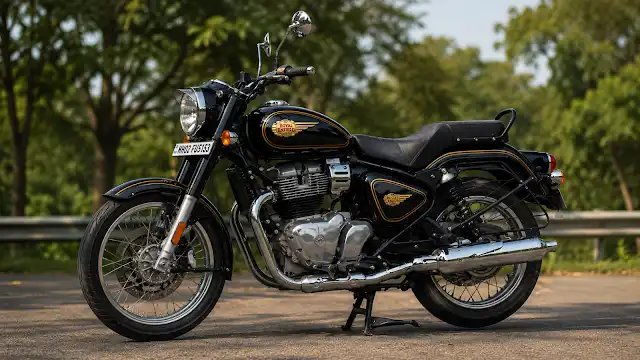
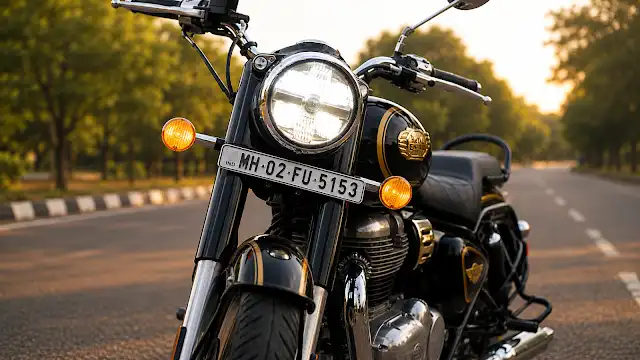
Its design makes it instantly recognisable. The Bullet 650 still looks like a Bullet. The round headlamp and the traditional ring are both there. The shape stays simple and old-school rather than sporty. A bit of gold detailing on the tank and a few other parts gives it a more premium, vintage appearance.
Chrome appears in quite a few places — the handlebar, the switches, the levers, and several other spots. It works well with the black body and gives the bike that proper retro feel people expect from a Bullet.
This is not a motorcycle that tries to look light or aggressive. It is best described as a lifestyle-oriented vehicle. The heavy metal-and-chrome appearance is one of the main reasons many people will choose it.
Features and Equipment
The design looks classic, yet the equipment is fairly modern.
An analogue speedometer sits on top with a small digital screen underneath. That screen shows the fuel level, gear position, clock, odometer and trip information.
There is also a separate round Tripper navigation unit on the tank. It links to a phone and gives turn-by-turn directions. Handy if you often ride to places you do not know well.
The main headlamp and tail lamp are LED, while the indicators stay round and classic. Royal Enfield has added modern bits without changing the basic Bullet character.
648cc Twin-Cylinder Engine
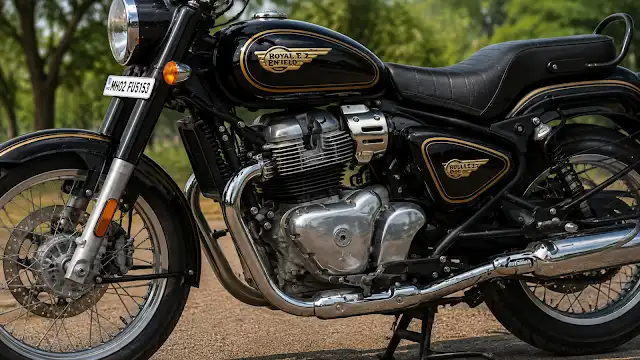
The biggest change from the Bullet 350 is the engine.
The Bullet 650 uses Royal Enfield’s 648cc parallel-twin. It makes around 47 PS and 52.3 Nm of torque. A six-speed gearbox and an assist-and-slipper clutch come as standard.
On the road, ad the engine feels smooth and easy to live with. The low-end response is comfortable, and the mid-range has enough power for clean overtaking. You do not have to keep changing gears every few seconds in normal riding.
The top end is stronger than most people expect from a traditional Royal Enfield single. Power keeps building as the revs rise, so the bike does not feel weak when you ask for more.
Flexibility is one of the best things about this engine. You can pot along in fourth gear at 20–30 km/h without the engine complaining. Even in sixth, it will cruise smoothly at 50–60 km/h when the road allows.
For riders weighing up long-term fuel and running costs against everyday transport options, our car buying guide for India breaks down practical ownership maths.
On the highway, 100–110 km/h feels like a sensible cruising speed. Some vibration still comes through the handlebar and foot pegs at higher speeds, but it stays manageable.
242 kg Weight: The Biggest Drawback
One thing you cannot ignore is the weight.
The motorcycle tips the scales at around 242 kg. That makes it one of the heavier bikes in Royal Enfield’s 650 range.
You notice this weight when you push the bike around while it is parked. Reversing, making a tight U-turn, or threading it through a narrow parking space takes real effort. In heavy traffic, ic the constant stopping and starting can also become tiring.
Once you are moving, things change.
The weight gives the bike a planted feel on the road. At normal speeds, eds it feels stable and controlled. The slightly longer wheelbase compared with the Classic 650 also helps with straight-line stability.
So the weight is a clear disadvantage in the city, but it can turn into an advantage on an open highway.
If you are curious about how heavier platforms handle highway journeys across India, checking our Tata Harrier EV review and real-world range analysis offers a solid benchmark.
Highway Ride and Comfort
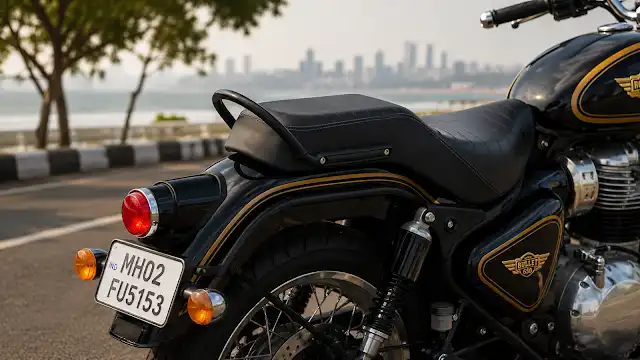
This is where the Bullet 650 makes more sense.
On an open road, the motorcycle feels stable and confident. It does not get nervous easily, even when the surface is not perfect. The longer wheelbase helps the bike stay settled at highway speeds.
The single-piece seat is another good point. It has decent cushioning and is shaped more for relaxed riding than for sporty positions. Seat height is about 800 mm, which should suit most average-height riders.
The suspension and seating position make the bike suitable for long rides. It is not trying to push you to ride hard. Instead, it encourages a relaxed style.
City Riding and Cornering
City riding is a different story.
The 242 kg weight becomes obvious when you are stuck in traffic. Filtering through narrow gaps is harder than on a lighter motorcycle. Tight U-turns need more planning as well.
You cannot just flick the Bullet 650 into a tight corner. The weight and size are noticeable when you change direction.
Once you settle into a bend, though, the bike feels stable. It holds its line well and does not feel nervous.
In simple terms, the Bullet 650 is happier on straight roads and sweeping corners than on tight, technical ones.
Braking Performance
The bike has a 320 mm front disc and a 300 mm rear disc, plus dual-channel ABS.
Braking is adequate for a motorcycle of this size. Because of the weight, smooth and progressive braking works better than sudden hard stops.
Aggressive braking can show the limits of tyre grip, especially on poor surfaces. Controlled use of the brakes is the smarter approach.
Real-World Mileage
The Bullet 650 is not built for small-bike fuel economy.
With the 648cc twin and the heavy body, a real-world figure of around 20–25 kmpl is realistic.
In busy city traffic, ic you might see closer to 20–22 kmpl. On a relaxed highway run with steady speeds, it can climb toward 25 kmpl.
For a bike of this size and weight, those numbers are acceptable.
Bullet 650 vs Classic 650
Both bikes share the same basic engine platform, but they feel different.
The Bullet focuses on traditional styling, the single-piece seat, and a relaxed riding experience. Its slightly longer wheelbase also gives a more stable feel on straight roads.
The Classic 650 may suit riders who prefer its particular look and riding position. If comfort, relaxed cruising and highway work matter more, the Bullet 650 has the edge.
Royal Enfield Bullet 650 Specifications
| Feature | Details |
|---|---|
| Engine | 648cc Parallel-Twin |
| Power | 47 PS |
| Torque | 52.3 Nm |
| Gearbox | 6-Speed |
| Clutch | Assist & Slipper |
| Kerb Weight | Approx. 242 kg |
| Seat Height | 800 mm |
| Front Brake | 320 mm Disc |
| Rear Brake | 300 mm Disc |
| ABS | Dual-Channel |
| Real-World Mileage | Approx. 20–25 kmpl |
| Expected Price | Around ₹3.65 lakh, ex-showroom |
Final Verdict
The Royal Enfield Bullet 650 is not meant to be a light daily commuter. Its main appeal is the mix of classic Bullet styling, a strong twin-cylinder engine, and comfortable highway manners.
The 242 kg weight is a real drawback in crowded city traffic. That same weight helps the bike feel planted once you reach an open road.
The engine is smooth, the mid-range is strong, the seat is comfortable, and the 100–110 km/h cruising range makes it a solid choice for relaxed highway trips.
At around ₹3.65 lakh ex-showroom, it sits in an interesting spot in Royal Enfield’s 650cc line-up.
If you want a motorcycle with a traditional look, solid road presence and enough performance for long rides, the Bullet 650 makes a convincing case. Just remember one thing before you buy it: this is a heavy bike, and you will notice that weight every time you have to move it slowly or handle it in tight spaces.