Renault Triber vs Maruti Brezza – Which One Actually Fits an Indian Family?
Cars in the ₹8–10 lakh range keep coming down to these two. The Triber and the Brezza try to solve the same family problem, just in very different ways.
One is a small seven-seater that can be rearranged. The other is a regular five-seat SUV that most people already recognise. The real test is which one still feels right after months of school runs, traffic and weekend trips.
On the Road
They don’t feel the same.
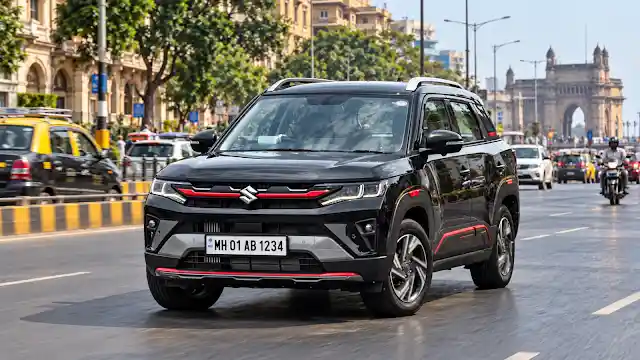
The Brezza drives like a normal family SUV. It’s light around town and has enough power for highway work. Four adults plus a boot full of bags and you might need to drop a gear before overtaking, but it stays relaxed. The gearbox is easy – no fighting it in traffic, and the higher gears keep things quiet on long stretches. If you want to know how the newer Boosterjet motor stacks up against the old engine on open roads, read our detailed Maruti Brezza Turbo review (1.0L vs 1.5L).
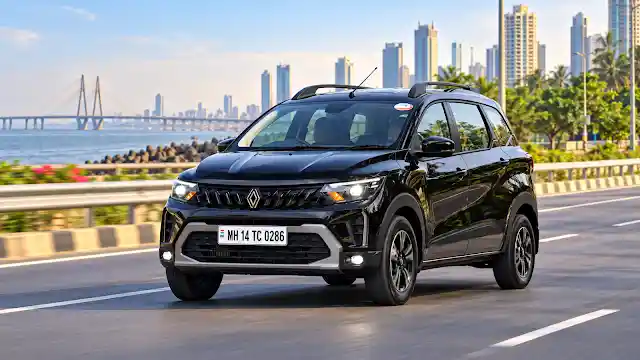
The Triber is a different animal. Speed was never the point. It’s a compact car that can take more people when you need it. Five or seven passengers, and you plan overtakes a bit more carefully, especially on a climb. The right gear makes a clear difference. You don’t buy this car to fly past trucks. You buy it for the days those two extra seats actually get used. For a deeper breakdown of how this small engine pulls under load, check our in-depth Renault Triber Turbo review.
If most of your weekends involve family, that difference shows up quickly.
Real-World Fuel
Driving style decides almost everything here.
Stop-start traffic, AC on full, and a loaded cabin will pull the numbers down fast. Someone who stays light on the throttle will always do better than the person who floors it at every green light.
Rough figures from our runs:
- Heavy city traffic – Triber 9.5–11 km/l, Brezza 10.5–13.5 km/l
- Steady 80–90 km/h – Triber 16–17.5 km/l, Brezza 19–21 km/l
- Hills with full load – Triber 8.5–9.5 km/l, Brezza 9–10 km/l
These aren’t brochure numbers. Your own results will move around depending on traffic and how you drive. Cover a lot of kilometres every month and even a small difference starts to add up over a year. Worth thinking about before you put money down.
The Triber’s Real Advantage
This is where the Triber starts making sense for a lot of families.
Most owners won’t use the third row every day. But when relatives visit, the kids bring a friend, or the whole family has to go to a wedding, those two seats suddenly become useful.
The middle row slides for more legroom and the rear seats fold flat when you don’t need them. Some of the plastics feel basic, and a few bits look cost-conscious – that’s normal at this price. The layout itself is clever.
Short trips are fine for kids and teenagers. Smaller adults can manage the third row too. A long journey with seven adults is a different story – keep expectations realistic.
Luggage
With all seven seats up, the boot is the weak point. Small bags are fine. Big suitcases need planning.
Fold the rear seats and the car changes completely. Suddenly you have a useful little load carrier. That kind of flexibility is hard to find in a normal five-seat SUV.
Where the Brezza Feels Stronger
The Brezza doesn’t pretend to be a seven-seater. It just does the five-seat job properly.
Front seats are comfortable day-to-day. The cabin has a more conventional SUV feel. For a couple or a family of four, this can actually be better – you’re not staring at empty seats every day. The rear bench works best for two adults on a long drive. Three can sit, but the middle person doesn’t get much room.
The boot is simple. Bags go in, tailgate closes, done. No folding required.
Indian Roads
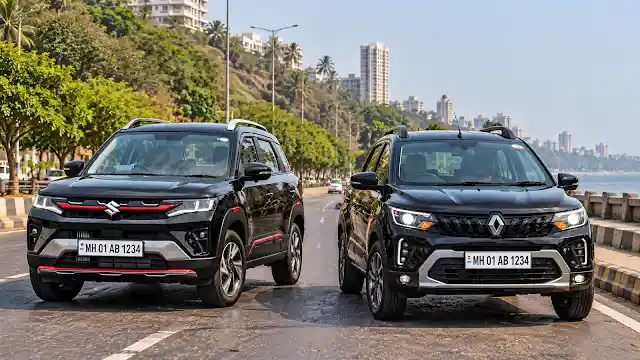
This matters more than most showroom talk.
Both cars handle normal speed breakers and rough city roads without drama. The gap appears when the surface is properly broken. At higher speeds, the Brezza feels more planted – solid weight and the suspension keep things under control.
The Triber is softer at city speeds. Over small bumps, it can feel more comfortable. With a full cabin, you notice more body movement when you change direction quickly.
Mostly city driving? Either works. Lots of highway kilometres on rough roads? The Brezza feels more settled.
Service
Maruti’s biggest advantage often isn’t the car – it’s the network.
Any large city has a Maruti workshop nearby. Even in smaller towns, parts and independent garages are usually easy to find. Renault has improved, but the network is still thinner.
That doesn’t make the Triber expensive to run. Just check the nearest authorised workshop and ask about regular service costs before you buy. A lower purchase price doesn’t help much if service becomes a hassle later. If long-term maintenance and fuel choices like CNG or E20 are on your mind, look into our Maruti Brezza 1.0L Turbo vs 1.5L ownership comparison.
Safety
Don’t decide on a star rating alone.
The Brezza has electronic stability control and ISOFIX mounts on many variants. Higher ones add more cameras and convenience features. The Triber also has a decent set of safety equipment, but it changes with the variant and the year.
Look at the exact model year, the standard safety list, and any independent crash-test data. That’s the only proper way to compare.
Which One Should You Actually Buy?
It depends on how you travel.
Go for the Triber if:
- You need seven seats sometimes
- You want a cabin that can change shape
- Extra space for family is useful
- You fold the rear seats for luggage often
- Most driving is in the city
- You want maximum practicality on a tight budget
It works for families that occasionally need more seats but don’t want a big MPV.
Go for the Brezza if:
- Five comfortable seats are enough
- You prefer a traditional SUV feel
- You do regular highway runs
- You want a more settled feel at higher speeds
- Easy service network matters
- Resale value is important
If you usually travel with three or four people, buying a seven-seater just for the two extra seats doesn’t make much sense.
Quick Questions
Can seven adults travel in a Triber? Yes, but luggage becomes the problem. With every seat taken,n there’s almost no room for big suitcases. Short family outings are manageable. A week-long trip with seven adults needs careful packing.
Which is better on hills? Neither car should stay in a high gear on a steep climb just to avoid shifting. Use the gearbox properly and keep the engine in its useful range. The Brezza feels more comfortable when you need to hold speed on the highway. The Triber’s priority is carrying people, not strong acceleration.
Does the Brezza come with CNG? Yes. Maruti has offered a factory CNG version. The CNG model feels different and has different running costs. If CNG is important, compare the exact petrol and CNG variants side by side.
Final Thoughts
These two cars suit slightly different buyers.
The Triber tries to stretch a small budget further. Seven seats, flexible seating, and the ability to turn the cabin into cargo space give it a genuine advantage for some families.
The Brezza is the simpler choice. It works better for people who don’t need three rows and spend more time on the highway with a smaller group.
If parents, kids, and relatives regularly travel together, those two extra Triber seats can save a lot of inconvenience. If your normal load is four or five people and you want something that feels more natural on the highway, the Brezza is the better match.