New Maruti Baleno First Look: New Z-Series Engine, Level 2 ADAS and What Has Changed
Maruti Suzuki has given the hatchback a major refresh, with the official New Maruti Baleno Price starting at an introductory ₹6.09 lakh ex-showroom for the Sigma trim. More than 19 lakh Baleno have been sold in India since the car was launched, keeping it right at the top for buyers exploring the [best cars under ₹10 lakh].
The changes are not limited to the exterior. Maruti has also changed the engine and added new safety and comfort features. Here is a closer look at what is new, what remains the same, and what Maruti has decided to leave out.
A New 1.2-Litre Z-Series Engine
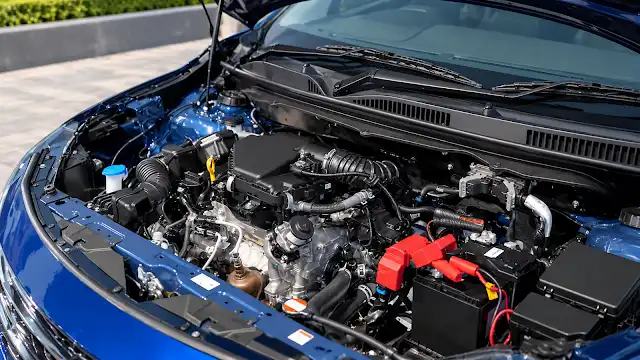
The biggest change is under the bonnet.
Maruti has replaced the older four-cylinder K-Series petrol engine with the 1.2-litre Z-Series three-cylinder unit also used in the Swift and Dzire.
The new engine produces 80.6 bhp and 111.7 Nm of peak torque. Those figures are slightly lower than the older engine, and drivers moving from the four-cylinder Baleno may notice that the new motor feels different.
However, the three-cylinder engine has been developed with efficiency and everyday running costs in mind. That should make it a sensible choice for buyers who spend most of their time driving around town.
Transmission choices are straightforward. You can have a 5-speed manual or Maruti’s AGS automatic. There is still no turbo-petrol engine or conventional torque-converter automatic.
Fresh Look at the Front
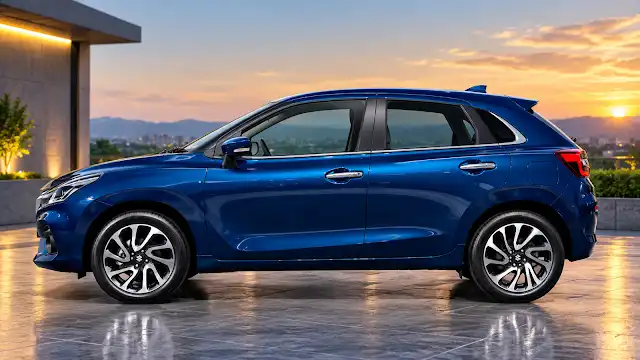
Most of the exterior changes can be seen at the front.
The Baleno now has a lower-looking nose and a wider grille, giving the hatchback a slightly sharper appearance. The triple-arrow LED projector headlamps continue, while the indicators and lower LED fog lamps remain around the bumper.
Maruti has also added a new 3D-style garnish on the front wings, finished in chrome and gloss black.
Ground clearance remains 170 mm. The car continues with front disc brakes, rear drum brakes and 16-inch geometric-cut alloy wheels. A new Enigmatic Teal paint colour has also been added.
At the back, the design is largely unchanged. The split LED tail-lamps, lip spoiler, reversing camera, rear wiper-washer and four-sensor parking system are still there.
The boot remains practical too, with enough room for two medium-sized suitcases and a soft duffel bag above the spare wheel.
Ventilated Front Seats Added
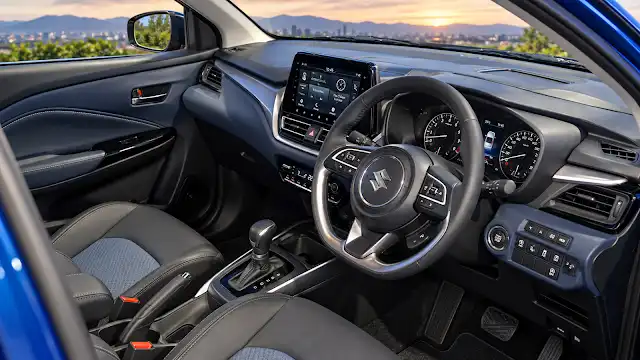
The cabin will look familiar to existing Baleno owners, but there are a few useful additions.
One of the most noticeable is the ventilated front seats. They should be particularly useful during India’s hot summer months. The seats use a breathable centre section with leatherette-style bolsters, allowing air to pass through the seating surface.
The wireless charging pad has also received an interesting upgrade. It now has cooling vents, which should help keep a phone from becoming too hot when it is charging while navigation is running.
Other equipment includes the 9-inch Smart Play Pro+ touchscreen, wireless Android Auto and Apple CarPlay, a colour Head-Up Display and a 360-degree camera.
Rear passengers continue to get decent knee and legroom, along with rear AC vents and two USB charging ports, including Type-A and Type-C connections.
There are still a couple of familiar drawbacks. The floor has a small centre hump, and rear passengers do not get a folding centre armrest.
Real-World Fuel Efficiency: What Can You Actually Expect?
Maruti’s shift to the 3-cylinder Z-Series engine was driven entirely by fuel economy targets. Out on real roads, here is what the manual variant delivers across different environments:
- City Stop-and-Go: Expect between 14 km/l and 17 km/l during typical urban bumper-to-bumper commutes with the air conditioning running continuously.
- Highway Cruising (80 km/h): Sticking to the recommended expressway cruising speed yields an impressive 18 km/l to 22 km/l when driven with a disciplined, light right foot.
- High-Speed Motorway Runs (120 km/h+): Pushing beyond three-digit speeds drops consumption down to roughly 15 km/l to 16 km/l.
- Steep Mountain Climbs: Navigating sharp hilly switchbacks drops economy down into the 8 km/l to 11 km/l territory.
Safety Gets a Major Boost with Level 2 ADAS
Safety is one area where the updated Baleno takes a significant step forward.
Six airbags, ABS with EBD and ISOFIX child-seat mounts continue to be part of the package. On higher variants, Maruti has now added Level 2 ADAS. Much like the radar tech seen on larger family SUVs such as the MG Hector Tomahawk PHEV, this brings active assistance into a far more accessible segment.
The system uses a camera mounted near the windscreen along with a radar unit at the front. Depending on the system and driving situation, it can provide features such as Adaptive Cruise Control, Lane Keep Assist and Autonomous Emergency Braking.
If you are buying a Baleno equipped with ADAS, it is worth going through our New Car PDI Checklist before completing the paperwork. Make sure the camera and radar are correctly fitted, sensor alignments are intact, and the related electrical functions work properly.
Features Maruti Has Still Left Out
Despite the extra safety and comfort equipment, the updated Baleno does not get every feature that some buyers may have expected:
- There is still no factory-fitted underbody CNG tank. CNG versions therefore continue with the conventional luggage-space tank arrangement.
- A sunroof is also missing, so the Baleno retains its standard steel roof.
- Oversized Front Headrests: The unusually large headrests on the front seats obstruct forward visibility for rear-seat passengers and partly restrict air circulation towards the back row despite rear AC vents being present.
- The cabin lighting remains another. old-fashioned touch:Instead of modern white LED units, the car continues with conventional halogen bulbs.
- No Rear Center Armrest: In a hatchback marketed strictly as a premium product, rear passengers still do not get a foldable center armrest or dedicated privacy curtains.
These omissions may not matter to every buyer, but they are worth knowing before making a final decision.
Price and Verdict
The new Maruti Baleno starts at an introductory ₹6.69 lakh ex-showroom for the Sigma variant.
With the Z-Series engine, additional equipment and Level 2 ADAS on higher variants, Maruti has made a clear attempt to keep the Baleno competitive with rivals such as the Hyundai i20 and Tata Altroz.
For someone looking for an easy-to-drive city hatchback, low running costs, good fuel efficiency and a stronger safety package, the updated Baleno remains a sensible choice.
The switch from a four-cylinder engine to a three-cylinder unit may take some getting used to, especially for existing Baleno owners. Even so, the overall package is still practical and well suited to everyday Indian driving.
New Maruti Baleno: Quick Buyer Queries
How much does the entry-level Baleno actually cost on road papers?
Showroom pricing starts at an introductory ₹6.69 lakh for the base Sigma trim. Maruti planned this discount purely for festive Diwali walk-ins, so expect standard price hikes shortly afterwards.
Why throw away the proven four-cylinder K-Series engine?
Strict BS6 Phase 2 emission norms and pure mileage targets forced the shift. Dropping one cylinder brings in the 1.2-litre Z-Series 3-pot unit rated at 80.6 bhp and 111.7 Nm, paired up with a 5-speed manual or AMT gearbox.
Can you get Level 2 ADAS on lower or mid variants?
No chance. You must pay up for top variants to get the front windshield optical camera and lower grille radar block. Only those top models give you active driver aids like Adaptive Cruise Control, Lane Keep Assist, and front collision avoidance braking.
Do cooled seats actually blow air through fabric material?
They really do. Instead of slipping slippery leather everywhere, Maruti stitched breathable cloth right in the middle section while keeping leatherette on side bolsters. Air blowers pump fresh breeze straight through that fabric weave on sweaty afternoons.
Did Maruti fix the boot luggage issue with an underbody CNG tank?
Not happening on this model. Buying an S-CNG variant still means parking a large gas cylinder directly inside the boot, eating up the luggage floor just like the older car.
Did Maruti finally add an electric sunroof?
Still no sunroof on offer. Maruti decided against cutting open the roof panel, keeping solid steel overhead across the entire line up.