Nissan Tekton Review: Is Nissan’s Take on the Duster Worth Buying?
You remember the old Duster and Terrano days, right? Feels like those times are looping back again. Nissan has gone and built its own midsize SUV using the exact same mechanical platform as the upcoming Renault Duster. Under the skin, they are basically twins. Once you start looking at the exterior and sitting inside, though, the personality changes completely.
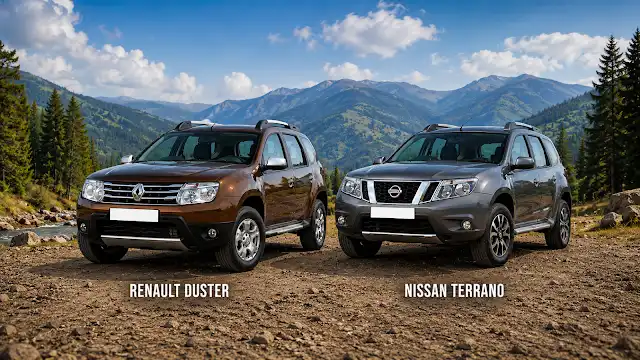
Nissan is calling this new design language “Baby Patrol”. I got to spend proper time with the 1.3-litre turbo petrol DCT version to figure out if this one actually brings enough character, feel and performance to make you open your wallet, or if it’s just a clever badge job.
Outside
Look, standing right in front of it, the stance feels far more imposing than what Renault came up with. You get this tall, squared-off grille with an illuminated LED strip connecting both headlamps, while the lower bumper gets extra black cladding to look tough. The wheels fill the arches nicely – they are 18-inch cut alloys with 225/55 section rubber.
The most practical bit has to be the ground clearance. At 212 mm unladen, you simply do not stress about cracked tarmac, speed bumps, or monsoon waterlogging catching the underside. On the front doors, Nissan added small badges showing off the torque rating – T280 on this 1.3-litre model and T160 on the base 1.0-litre car. Out back, the smoked tail lamps join in the middle above a thick faux bash plate.
Inside
Open the door, and the difference is immediate. Look, the cabin feels far more airy than the Duster’s dark, moody layout. The dash mixes dark top plastics with deep wine-red soft panels, slim rose-gold trim, off-white accents, and pale seat fabrics. It just feels like a much nicer space to sit in during daily commutes.
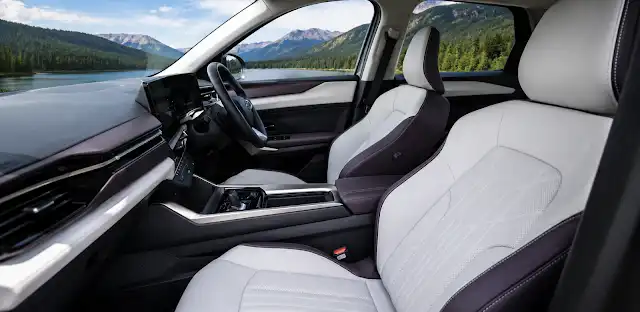
On the tech and comfort side you get a 9-inch touchscreen that supports wireless smartphone mirroring, a crisp digital instrument cluster, Level-2 ADAS with adaptive cruise and lane-keep assist, a tilt-and-telescopic steering wheel with paddle shifters, front ventilated seats, a panoramic sunroof, a wireless charger that has active cooling, and a 360-degree camera with dynamic guidelines. When looking at modern car touchscreen safety and driving distraction, having intuitive physical toggle backups for basic cooling controls makes everyday driving far less annoying. The dual-zone climate control cools the cabin quickly even when the sun is beating down hard and doesn’t keep cutting the compressor in and out.
Rear seat space is decent for two adults and a child. Anyone over six feet will start feeling the legroom on longer highway stretches, especially if you are used to the expansive third-row cabin space of larger 7-seater family SUVs. Safety feels properly sorted with a 5-star BNCAP crash score, six airbags fitted across all models, electronic stability control, and tyre pressure sensors.
Engines and road manners
Under the bonnet, which thankfully lifts on hydraulic struts, you pick between two petrol units:
- The entry 1.0-litre turbo engine gives you 100 PS and 160 Nm, paired only to a 6-speed manual gearbox.
- The bigger 1.3-litre four-cylinder turbo pushes out 163 PS and 280 Nm, available with a 6-speed manual or a 6-speed wet-clutch DCT automatic.
On tarmac, that 1.3 dual-clutch pairing is clearly the star. Off idle in Eco mode, power comes in gently, but push past 1800 rpm, and the turbo spools with a faint whistle, pulling eagerly right up to motorway speeds. Slotted into Comfort or Sport, closing gaps in fast-moving traffic feels effortless. The wet-clutch gearbox shifts smoothly rather than snatching gears aggressively, which should help long-term wear. High-speed stability is reassuring, and road tyre roar stays well muted.
Fuel economy in the real world
Talking to drivers using the 1.3 DCT on daily runs, here is what the trip computer actually reads:
- Crawling city jams: roughly 7 to 9 km/l
- Moving suburban traffic: around 10 to 12 km/l
- Steady motorway cruise at 85 km/h: between 14 and 16 km/l
If you calculate running costs based on pump prices, it works out to roughly ₹8 to ₹10 per kilometre.
Final take
To be fair, picking the Tek ton over its sibling boils down to two simple things:
- You prefer the mini-Patrol front grille and the brighter multi-toned cabin over the darker Duster interior.
- Your regional Nissan dealership enjoys a stronger reputation for after-sales support and friendly staff than the neighbouring Renault facility.
Initial customers among the first 10,000 bookings receive a complimentary 5-year maintenance package alongside standard factory warranty. For long-term peace of mind, extended coverage stretches up to 7 years or 1,50,000 km.
Quick FAQs
How much road clearance does it offer?
It provides 212 mm of clearance, letting you glide over harsh bumps and uneven surfaces without belly contact.
Is there any diesel or self-charging hybrid?
No. Nissan is strictly sticking with the 1.0-litre and 1.3-litre turbo-petrol options for this model.
What safety equipment comes included?
Every car gets a 5-star BNCAP safety rating, six cabin airbags, stability control, hill hold, and Level-2 radar driver aids.
What fuel economy does the 1.3 automatic return?
Plan for around 8 to 11 km/l in standard town traffic and 14 to 16 km/l during steady open road journeys.
Does it feature front cooling seats and a glass roof?
Yes. Higher variants come equipped with front seat ventilation, a panoramic glass roof, and dual-zone climate settings.