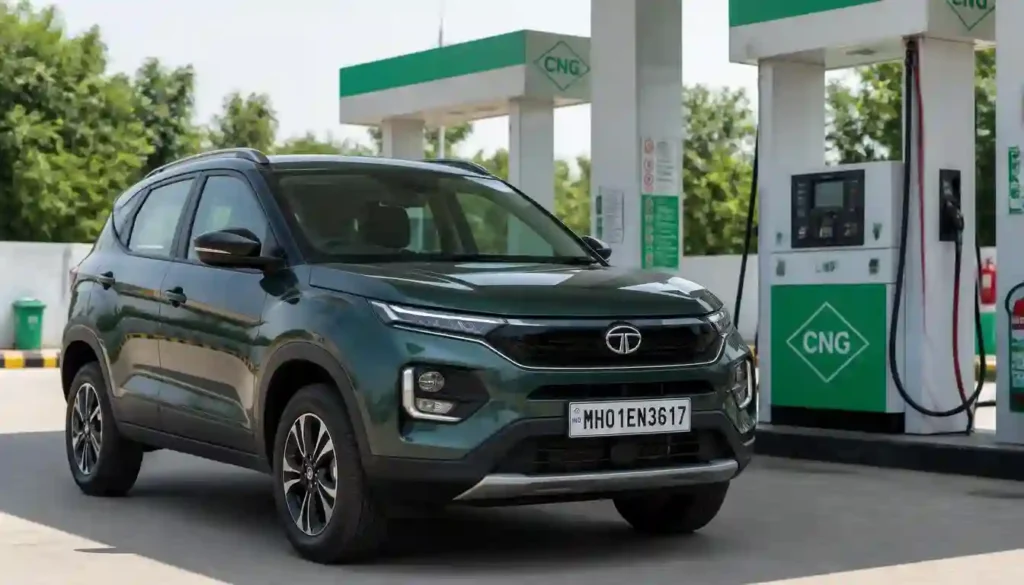
Factory Fitted CNG Cars: Single Cylinder, Dual Cylinder or Underbody – Which One Should You Buy?
Buying a CNG car used to be very simple. You took a basic hatchback, accepted that the whole boot is gone, and enjoyed cheap running costs.
Today the market is full of options. Companies are offering three different factory-fitted CNG setups:
– Traditional single large cylinder
– Space-saving dual small cylinders
– Underbody CNG tanks
Further complicating matters, inexpensive aftermarket CNG conversion systems continue to be sold and installed by local garages. Choosing the right one has become confusing. Before you go to a showroom and spend your money, let’s understand which setup actually suits your daily use.
Why Aftermarket CNG Kits Are Not Worth It Anymore
Many people still remember the time when everyone used to go to local mechanics and fit cheap CNG cylinders in their petrol cars. Those days are mostly over.
Aftermarket kits may look cheaper in the beginning, but they bring big problems. Local fitment often has poor wiring, weak brackets, and low-quality parts. The check engine light keeps coming on, and safety is always a question mark.
Factory-fitted CNG cars changed everything. Companies give:
– Proper strong mounting and crash-tested tank fitting
– ECU that is properly mapped so switching between petrol and CNG is smooth
– Full RTO and insurance approval without extra headache
Today most buyers want proper safety. Aftermarket kits are slowly dying. Factory-fitted is now the only sensible choice.
Single Large Cylinder – Maximum Range for Budget Cars
This is the old-style setup. One big 60-litre cylinder is fixed inside the boot.
Advantage
It holds more gas in one fill. In light hatchbacks, you can easily get 190 to 215 km real range. You don’t have to stand in the CNG queue again and again. Initial price is also lower than dual-cylinder cars.
Drawback
Boot space is almost finished. Keeping a big suitcase becomes very difficult.
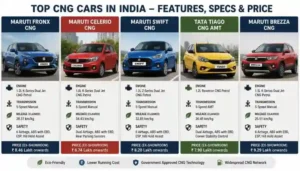
Best cars in this setup
– Maruti Fronx and Celerio – good for pure city use if you don’t care much about luggage
– Maruti Swift – solid choice for daily office commute where running cost is most important
– Tata Tiago CNG AMT – if you want an automatic gearbox without going for an aftermarket kit
Within the compact SUV market, the Maruti Brezza CNG continues to hold a strong position. On the highway, it easily gives around 190-200 km. Because the car is bigger, you can still keep two or three medium bags around the cylinder.
Dual Cylinder – Boot Space Comes Back
Tata started this idea. Instead of one big cylinder, they put two slim cylinders under the boot floor.
Advantage
You get usable boot space again. You can keep full luggage, shopping bags, and travel bags without losing the CNG benefit.
Drawback
Price is a bit higher than single-cylinder cars. Long-term maintenance is also slightly higher because there are two cylinders and more pipes.
Best cars in dual-cylinder setup
– Hyundai Exter CNG – compact crossover with good service network and decent boot
– Tata Punch CNG AMT – high ground clearance + automatic, very practical for city
– Tata Nexon CNG – good for people who do highway runs and need power for overtaking along with luggage space
Also Read: Thinking of skipping gas queues altogether for daily city runs? Read our Electric Scooter vs Petrol Scooter guide to calculate real savings.
Underbody CNG – Full Boot Space but Spare Wheel Goes
Maruti brought underbody CNG (seen in some models). Here the cylinders are fitted under the car, outside the boot.
Advantage
You get complete boot space, exactly like a normal petrol car.
Drawback
Spare wheel is removed. The company gives a puncture repair kit and a 12V inflator instead.
Is a missing spare wheel a big problem? For city use, mostly no. Advancements such as tubeless tyres, combined with improved roads, have significantly reduced the frequency of punctures. But if the tyre gets a big sidewall cut on a lonely highway, the repair kit will not help.
Some people buy an extra spare wheel and keep it in the boot, but then the whole point of underbody CNG is lost.
What About CNG Sedans?
If you want the comfort of a sedan, two clear options are there:
– Hyundai Aura CNG – comfortable, feature-loaded, smooth for city
– Maruti Dzire CNG – still the king for low maintenance and high mileage. 5-star safety and strong resale make it a favourite for both private buyers and commercial use
Final Words
Which CNG setup is best depends on how you use the car:
– Go for a single cylinder (Brezza, Fronx, Swift, Tiago) if you want maximum range and lower price, and luggage is not a priority
– Go for dual cylinder (Punch, Nexon, Exter) if you travel with family and need proper boot space
– Go for underbody only if full boot space is most important and you are okay without a spare wheel
Always choose factory-fitted. Stay away from local aftermarket kits.
Also Read: Looking for a rugged SUV instead of a compact CNG car? Check out our comparison on Scorpio N vs Thar Roxx before making your decision.
Common Questions
1. Is an aftermarket CNG kit still okay for new cars?
No. Modern engines and strict safety rules make aftermarket kits risky. Factory-fitted is safer, has proper ECU mapping, and insurance is easy.
2. Which CNG car gives best mileage and range?
For everyday use, lightweight hatchbacks such as the Celerio and Wagon R remain highly regarded for their fuel-efficient performance. In a compact SUV, Brezza CNG still gives one of the best real highway ranges (around 190-200 km).
3. Does dual cylinder reduce gas capacity?
Not really. Two smaller cylinders together hold almost the same gas as one big cylinder, but you get boot space back.
4. What if I get a puncture in an underbody CNG car?
The company gives an inflator and puncture sealant. A normal nail puncture is easy to fix. Big sidewall damage will need roadside help, or you have to carry your own spare.
5. Are AMT CNG cars reliable for the city?
Yes. Tiago CNG AMT and Punch CNG AMT work well in traffic. You get low running costs with automatic convenience.