Maruti Brezza Turbo Review: Does a 1.0L Engine Beat the 1.5L?
For years, most Indian car buyers treated three-cylinder engines like a compromise. Noisy, gutless, full of vibes, and nowhere near as refined or durable as a proper 1.5-litre four-cylinder. Highway pull? Forget it. People just assumed smaller capacity meant you’d always be playing catch-up.
Maruti just called that bluff.
They’ve brought back the 1.0-litre BoosterJet turbo petrol, paired it with a proper six-speed manual and mild-hybrid tech, and the result feels noticeably livelier than the old 1.5L Brezza. If you’ve been tracking upcoming SUVs in India, this new turbo setup clearly shows where the market is heading. Not in a flashy way — just more eager when you need it.
Exterior and rainy-day presence
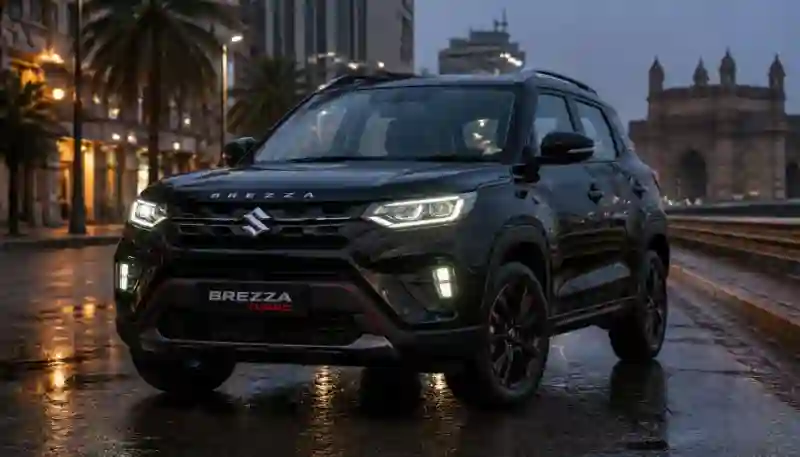
I drove one through a proper Mumbai downpour. The glossy black with the subtle red accents looked sharp even when everything else was grey and wet. Maruti hasn’t reinvented the shape — it’s still clearly a Brezza — but the small changes clean it up.
Up front there’s a restyled grille, bright LED headlamps, sharp DRLs and fog lamps sitting low in the bumper. From the side it keeps that tall stance with 198 mm ground clearance and a 2,500 mm wheelbase. 16-inch alloys wrapped in 215/60 rubber, thick cladding around the arches. At the back, you get the shark-fin antenna, roof spoiler and neat LED tail-lamps. ZXI and ZXI Plus Turbo trims add the rear wiper, washer and defogger. Both “Smart Hybrid” and “Turbo” badges sit on the boot lid. Pop the fuel flap, and there’s an E20 sticker — useful now that the government has confirmed the ethanol blend stays capped at E20 for the time being.
Cabin, comfort and kit
Inside, Maruti has loaded the Turbo variants properly, even the lower ones. Dark dash. Muted bronze accents. Rock-solid fit and finish. Nothing flashy, just tidy.
The 10-inch touchscreen is the centrepiece — wireless Apple CarPlay and Android Auto work without drama. Because of the mild-hybrid system, it also shows live power-flow graphics, so you can see when the battery is assisting or harvesting. The pop-up head-up display is genuinely useful: speed, climate tweaks, volume and nav arrows sit right in your line of sight so you’re not constantly looking down.
Front seats are good. Ventilated leatherette actually cools on a hot day, and visibility is excellent. You also get an auto-dimming IRVM, wireless charger, sliding armrest, 360-degree cameras and steering-mounted cruise control.
Rear seat space is decent for two adults — good thigh support, rear AC vents, Type-A and Type-C USB ports, 60:40 split and a fold-down armrest with cup-holders. Three-abreast is tight, though. Floor hump, no middle headrest, no privacy curtains. If family space is your top priority and you need extra rows, checking out a 7-seater buying guide might make more sense. And Maruti stuck with a small single-pane sunroof instead of a panoramic one.
Boot space is practical — three check-in bags or a couple of medium ones fit easily. Under the floor there’s a tray with the tyre inflator and toolkit. No spare wheel in this layout.
Driving, handling and the six-speed
The real story is under the bonnet. 110 PS and 170 Nm from the 1.0-litre three-cylinder BoosterJet. Turbo comes in early, so low-end pull is strong. Overtakes on the highway feel noticeably quicker than the old 1.5L naturally aspirated motor. Vibrations are well controlled for a three-cylinder. Acoustic windshield glass keeps cabin noise low, and when the mild-hybrid is working in city traffic, the whole thing feels calm.
The new six-speed manual is a clear improvement over the old five-speeder. Second and third gears cover stop-go traffic without constant shifting, while sixth keeps the revs down on the highway. Ride feels planted. Steering is light enough that tight U-turns in crowded streets are easy. One catch: no automatic option with this turbo engine. Manual only for now. That keeps the driver involved, but it will put some buyers off.
Real-world mileage
Turbo engines can get thirsty in heavy traffic, but the mild-hybrid start-stop system helps. From my runs:
– Heavy city traffic: 10–14 km/l
– Normal city driving: 16–17 km/l
– Open highways: 19–21 km/l
– Hilly roads: 9–10 km/l
Safety and the tax angle
Safety used to be Maruti’s soft spot. The Brezza now carries a full five-star rating for both adult and child occupants. The standard kit includes front discs, rear drums, rear parking sensors, 360-degree cameras, electronic stability control and traction control.
The bigger practical win is the tax structure. Sub-4-metre cars with petrol engines under 1.2 litres sit in the 18 % GST bracket. Engines over 1.5 litres jump to 40 %. By using the 1.0L turbo, Maruti keeps the cost down and passes most of that saving on. Base turbo trim starts at ₹7.40 lakh (ex-showroom). CNG pricing is still awaited, but the petrol turbo version already looks like a strong everyday choice.
Quick answers
Is the 1.0L Turbo faster than the old 1.5L?
Yes. With 110 PS and 170 Nm available early, acceleration and overtakes feel sharper than the previous naturally aspirated 1.5.
Crash safety rating?
Full five stars for both adult and child occupants.
Daily real-world mileage?
Around 10–14 km/l in heavy traffic, 16–17 km/l in normal city use, and 19–21 km/l on open highways.
Automatic option with the turbo?
Not yet. Manual six-speed only.