2026 Mahindra Thar OG Review: What Has Really Changed?
The two-door Mahindra Thar still has a different kind of appeal. You can buy a larger five-door SUV now, and it will obviously be easier for a family, but the original Thar has something the bigger version cannot quite replace. It is short, upright, chunky, and looks ready for an off-road trip even when it is parked outside a shopping centre.
If you are leaning towards a more practical, family-first electric SUV with modern tech, check out our detailed look at the Tata Sierra Pure L vs Pure Plus L comparison before putting your money down.
For 2026, Mahindra has updated this version and given it the Thar OG name. Prices start at around ₹10.32 lakh ex-showroom.

The first look does not reveal a huge change. The basic shape is still the same. The interesting part is what Mahindra has changed underneath and inside the cabin.
New Bumper and Bigger Wheels
The front end still looks instantly familiar, although there are some small changes.
The lower part of the bumper has been redesigned and now gets the ice-cube-style LED fog lamps. They sit below the C-shaped LED lighting elements, with the usual five-slat grille continuing to give the Thar its traditional face.
Another useful addition is front parking sensors. With the Thar’s tall bonnet and upright driving position, judging the front corners in a tight parking space was not always easy. The sensors should make city use a little less stressful.
Then there are the new 19-inch alloy wheels. They fill the large, square wheel arches much better and are matched with all-terrain tyres. Whether you actually need wheels this large on a two-door off-roader is another question, but visually they certainly make the SUV look more substantial.
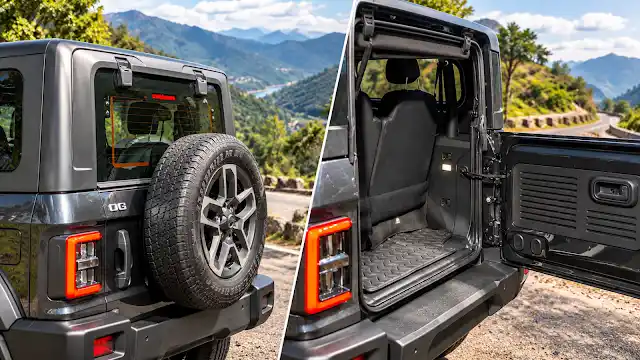
At the back, Mahindra has added an OG badge. The rest of the design stays true to the familiar Thar recipe, including the exposed hinges, chunky side steps and generous ground clearance.
The Suspension Is Where the Bigger Change Happens
This is probably the part existing Thar owners will be most interested in.
The older version was very capable away from the road, but it was not always particularly relaxing on the highway. Expansion joints, broken patches and sharp bumps could make the ride feel busy. The hydraulic steering was also quite heavy when manoeuvring at low speeds.
Mahindra has worked on both areas.
The suspension now uses frequency-dependent dampers. In everyday terms, the system is designed to deal with different types of road movement more effectively. Sharp bumps should feel less harsh, while the body should settle quicker after hitting a rough patch.
The other noticeable change is the move to electric power steering.
This matters much more in the city than it sounds on paper. Parking the Thar or making a tight U-turn should require considerably less effort than before. That makes the two-door SUV easier to live with when it is not busy climbing rocks or crossing muddy trails.
Stopping power has also taken a solid step forward with the addition of all-wheel disc brakes on upper trims. Even during sudden high-speed expressway braking from triple-digit speeds, the heavy ladder-frame chassis tracks straight without unsettling the rear axle.
Electronic 4×4 Controls
The 4×4 system has also been updated.
The driver can now select 2H, 4H and 4L electronically, while an electronic locking rear differential helps when traction becomes limited.
That matters when the Thar is being driven over loose sand, mud or slippery surfaces. Instead of relying entirely on wheelspin and driver inputs, the electronic system can help keep the available traction under control.
Mahindra has also added more insulation around the engine bay and firewall.
That may sound like a small detail, but diesel noise and vibration can become tiring during longer drives. The extra insulation is intended to keep more of that mechanical noise outside the passenger compartment.
A Less Basic Cabin
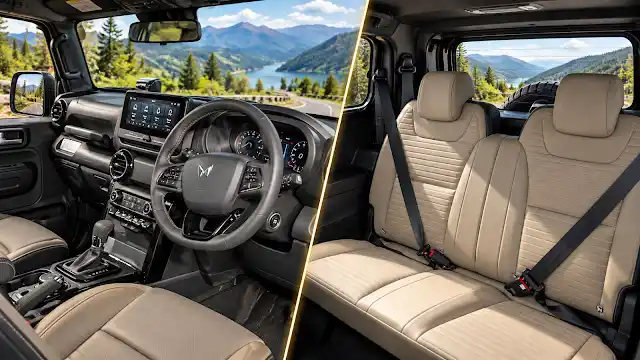
The Thar has always been more about function than luxury. The new version does not suddenly turn it into a premium SUV, but the cabin does get some welcome changes.
The truffle brown interior gives the dashboard and seats a warmer appearance. It is a noticeable change from the straightforward black treatment of the earlier cabin.
Charging options have also improved. There is a Type-C port, along with a conventional Type-A connection and a wireless charging pad on the lower console.
For people who actually take their Thar off-road, the updated touchscreen has another useful feature. It can display information such as pitch, roll and steering angle, giving the driver a better idea of what the vehicle is doing on uneven terrain.
The front seats have also been reshaped to provide more thigh support. That should be useful on longer drives, where a good seating position matters more than flashy cabin equipment.
There are also roof-mounted waterproof speakers, which make sense for an SUV that may regularly come back from a trail covered in mud and dust.
Three Engines Continue
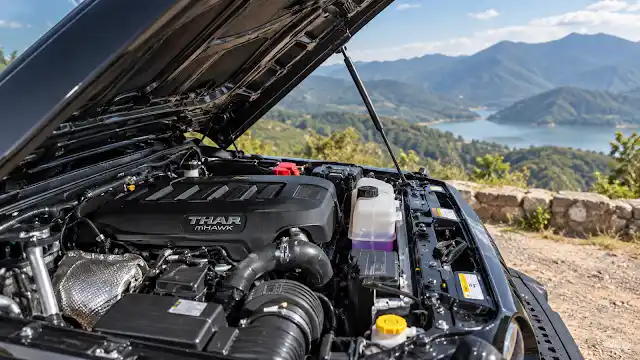
Mahindra has retained three engine options, with 6-speed manual and 6-speed torque-converter automatic gearbox choices.
1.5-litre CRDe Diesel
The 1.5-litre diesel is the more straightforward option for someone who likes the Thar’s design but does not necessarily need a full 4×4 setup.
With rear-wheel drive, it makes more sense for buyers who will spend most of their time driving around town and on normal roads.
If you are setting a strict budget and considering other options in this price bracket, explore our guide on the Best Cars Under 15 Lakh in India to compare all your choices.
2.0-litre mStallion Turbo Petrol
The 2.0-litre turbo petrol produces around 162 PS and 330 Nm.
There is enough punch here for highway driving, and overtaking should not be a problem when the road opens up. The downside is simple: frequent stop-start driving can push petrol consumption higher.
2.2-litre mHawk Diesel
The 2.2-litre diesel makes roughly 152 PS and 330 Nm.
Its strong torque delivery suits the Thar’s character particularly well. It is the engine that makes more sense when the SUV is going to spend time on difficult trails, carrying passengers or travelling long distances.
Out on the road, mechanical noise levels have dropped noticeably compared to the earlier model. Keep the rev needle under 2,200 rpm and the 2.2-litre motor pulls with clean refinement without filling the cabin with harsh diesel clatter. Push beyond 100 km/h and wind noise off the upright windscreen creeps in, but the strong mid-range torque makes highway overtakes effortless.
What About Fuel Costs?
This is something potential buyers should think about before buying any Thar.
A 2.0-litre turbo petrol or 2.2-litre diesel is not going to behave like a small hatchback when it is stuck in Mumbai, Delhi, or Bengaluru traffic all day. Short trips, constant braking, and crawling through traffic can all push fuel consumption higher.
In dense bumper-to-bumper city congestion, expect real-world mileage between 9 to 14 km/l depending on how heavy your right foot is. Out on open highway corridors cruising with smooth throttle inputs, the diesel returns a much more respectable 14 to 17 km/l.
So, if you are comparing a Thar with an electric SUV, don’t just look at the purchase price. Your monthly running distance and local fuel and charging costs can make a big difference.
You can use an EV vs Petrol Savings Calculator to get a rough idea of how the running costs compare.
Is the Thar OG Still the Same Thar?
In many ways, yes.
That is probably the point.
Mahindra has not tried to turn the two-door Thar into a completely different vehicle. The upright body, exposed hinges, short wheelbase, and chunky stance are still there.
The more important work has happened underneath. Better damping, lighter steering, improved insulation and electronic 4×4 controls address some of the complaints that mattered when using the old Thar on normal roads.
So the Thar OG remains a proper two-door Thar, but it should be easier to use when the nearest off-road trail is still several hours away.
At around ₹10.32 lakh onwards, the biggest question for buyers will not simply be whether it looks good. It will be whether they actually want the old-school two-door 4×4 experience enough to accept its compromises in everyday city driving.
Quick Answers: 2026 Mahindra Thar OG
What kind of cash do you need for the base model? Expect things to kick off around ₹10.32 lakh ex-showroom for the rear-wheel-drive 1.5-litre diesel. Naturally, tick the boxes for 4×4 or an automatic gearbox, and that number climbs close to the ₹19 lakh mark quickly.
Did Mahindra actually shove 19-inch rims onto this thing? They did. Walk up to the top-spec trims, and you will spot huge 19-inch alloys wearing beefy all-terrain rubber. It basically gets rid of that awkward empty gap inside the flared wheel arches.
Is it still a massive pain to steer around tight city lanes? Not anymore. Dropping the old, stubborn hydraulic steering for an electric setup genuinely changes the driving feel. You can whip it into a tight basement parking slot with one hand now instead of wrestling the wheel.
What engines are sitting under the bonnet? Pretty much the same three workhorses: the affordable 1.5-litre diesel for everyday city runs, the rapid 2.0-litre turbo-petrol pushing 162 PS, and the chunky 2.2-litre diesel making 152 PS for hardcore trails. Both manual and automatic gearboxes are on the table.
What changed underneath the floor pan? The rear gets a new Penta link setup with Watts linkage, paired with DaVinci frequency-dependent dampers. It stops the cabin from constantly pitching and bouncing over expansion joints on open highways.
How capable is the 4×4 hardware now? Properly capable. Beyond 4H and 4L, you now get electronic mode selection, dedicated terrain settings (Mud, Sand, Snow), and an electronic locking rear differential for sticky off-road trails.
Is it actually practical as an everyday family commuter? It is certainly more livable now thanks to front parking sensors, softer damping, and light steering. That said, it remains a tall two-door machine with tight rear seat access, so do not expect hatchback-like daily practicality.