New Audi Q3 Quattro 2026 Review: The Sane Luxury SUV for Indian Roads
Getting into an entry-level luxury SUV in India these days feels harder than it should. Prices keep climbing, rivals are everywhere, and the roads don’t care about your badge. Diesel rules in Delhi-NCR just add another layer of stress if you’re thinking long-term. Audi’s latest Q3 Quattro comes in with a clear brief — solid tech, proper safety, and all-weather grip instead of chasing pure drama.
It’s not trying to be the flashiest thing in the segment. What you get is a compact luxury SUV that feels thought-through for real Indian conditions. Here’s the breakdown.
Sharp Styling and 26,000 Micro-LED Headlamps

Up front, the Q3 looks purposeful. That big single-frame grille still dominates, but the lighting is the real upgrade. Audi’s Matrix LED setup packs roughly 26,000 micro-LED elements and can selectively cut light around oncoming cars. You keep the road lit without blinding the other guy. Daytime running lights let you cycle through a few different signatures if you like playing with the settings.
On the sides, Audi has kept things sensible with 18-inch alloys. Plenty of competitors push 19- or 20-inch wheels, but taller sidewalls make more sense here — they protect the rims and handle potholes better. Buyers who want to see how modern homegrown SUVs balance tall tyre profiles with daily family comfort can also check out our Tata Sierra Pure L vs Pure Plus L comparison. Roof rails are aluminium and understated; there’s a panoramic sunroof, and at the back you get that illuminated pink-red Audi badge plus clean, connected-style LED tail-lamps.
Cabin Tech: Curved Screens and a 12-Speaker Sonos Setup
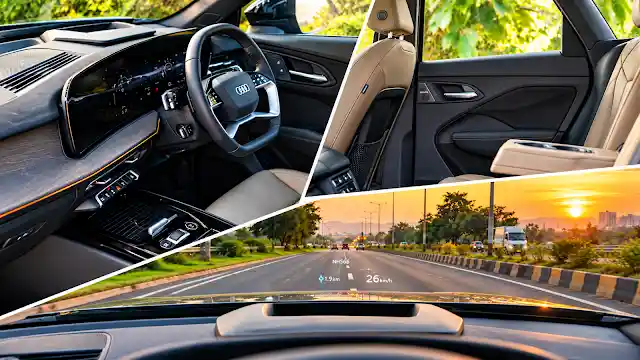
Inside, the cabin feels modern without going over the top. The dashboard tilts towards the driver, with its curved dual-screen arrangement offering a practical and user-friendly layout.
- 11.9-inch digital driver display handles maps and ADAS info cleanly.
- 12.96-inch MMI touchscreen is quick, runs Audi’s latest interface, and supports wireless phone connectivity.
- Sonos 12-speaker system delivers proper high-fidelity sound; the acoustic mode is a clear step up from the basic audio most cars in this class get.
- Dual-zone climate is touch-operated, but Audi still kept physical buttons for the important driving controls and the drive-mode selector.
Front seats are heated. The gear selector is now a simple toggle on the centre console with paddle shifters on the wheel. You’ll notice some harder plastics on the upper dash, yet the overall fit and the burnished trim still feel properly finished.
Practicality and Boot Space
Rear seats should work for families. They split 40:20:40 and offer a few stages of recline, so you can dial in decent under-thigh support on longer runs. Rear passengers get their own AC vents, fast-charging Type-C ports, and enough headroom even for taller adults thanks to the carved headliner. Manual rear sun blinds are the one small luxury touch that’s missing.
Boot space is a precise 488 litres. Flat loading lip, tie-down net, side bag hooks, and a space-saver spare under the floor. Packing for a trip is straightforward, with enough boot space to accommodate two medium suitcases alongside a few carry-on bags.
2.0L TFSI Engine and Quattro AWD Dynamics

The engine is Audi’s familiar 2.0-litre four-cylinder TFSI turbo-petrol. With 204 PS and 320 Nm on tap, the engine works with a smooth, quick-shifting automatic gearbox and supports E20 petrol.
The bigger story is the Quattro all-wheel-drive system. Front-wheel-drive rivals can get caught out on wet patches, mud or the occasional snow, while Quattro simply sends torque where it’s needed. Five drive modes are available through Audi Drive Select: Comfort, Dynamic, Balance, Efficiency and Off-Road.
Ride quality is one of the stronger points. It stays composed — no excessive float like softer SUVs, no bone-jarring firmness either. Steering is progressive and light enough that tight city U-turns and winding ghat roads feel easy.
City running returns roughly 6–9 km/l in heavy traffic. On the highway you’re looking at 10–13 km/l in normal conditions, and with a light right foot it can stretch to 14–15 km/l. If high daily fuel bills have you weighing premium petrol against zero-emission alternatives, run your daily numbers through our EV vs Petrol Savings Calculator to compare real running costs.
Enhanced Protection: 9 Airbags and Level 2 Driver Assistance
The safety kit is generous. You get:
- 9 airbags
- Level 2 ADAS with Adaptive Cruise Control (five distance settings)
- Front Emergency Brake Assist and Lane Keep Assist
- Driver Attention and Fatigue Monitor
- Hill Hold and Downhill Descent Assist
- ESP and traction control modes
A 360-degree camera and blind-spot warning are the two items missing from the list, though the front and rear parking sensors still do a decent job in tight spaces.
Expected Price and Market Verdict
The expected price range sits between ₹55 lakh and ₹59 lakh (ex-showroom).
If you’re after an all-weather luxury SUV that can deal with broken roads, skips the diesel-ban headache, and brings proper Quattro grip as standard, the new Q3 makes a strong, sensible case against the BMW X1 and Mercedes-Benz GLA. If you are also exploring electrified crossovers for long highway journeys, keep our EV Charging Stations Near Me directory handy to spot high-speed plugs along major routes.
Audi Q3 FAQs
What engine powers the new Audi Q3? A 2.0-litre four-cylinder TFSI turbo-petrol making 204 PS and 320 Nm.
Does the latest-generation Audi Q3 come equipped with AWD? Yes, Quattro is standard.
What is the boot space of the new Audi Q3? 488 litres with a flat loading bay.
How many airbags are fitted in the new Audi Q3? Nine as standard.
Does the Audi Q3 get ADAS features? Yes — Level 2 ADAS including Adaptive Cruise Control, Front Emergency Brake Assist and Lane Keep Assist.