Mahindra, Tata, or MG: Why 100 km daily runs make petrol or CNG a terrible idea
Look, almost every other day someone drops a message asking about 100 km daily running EV vs petrol. They clock eighty to a hundred kilometres daily between work and home. Normal Indian traffic, patchy bypasses, the usual drill. Yet the first cars on their shortlist are always mid-spec petrol crossovers or CNG hatchbacks.
Honestly, doing over 2,500 kilometres every single month with an exhaust pipe at the back is just burning money for no reason.
At that distance, getting an EV isn’t just about saving a bit at the pumps. Do the maths over four years and the fuel savings literally pay off the price of the car itself. Sales reps inside shiny showrooms won’t sit down and work this out for you over a cup of tea.
The real math behind 100 km a day
Let’s talk proper ground numbers.
Take a standard petrol crossover. In mixed Indian conditions, you will be lucky to see 13 or 14 km/l. Cover 2,600 km a month, and you are dumping between ₹18,000 and ₹20,000 straight into fuel stations. Go for CNG to cut corners, and your bill might drop to roughly ten grand. But then you waste half your weekend stuck behind sixty autos in gas queues.
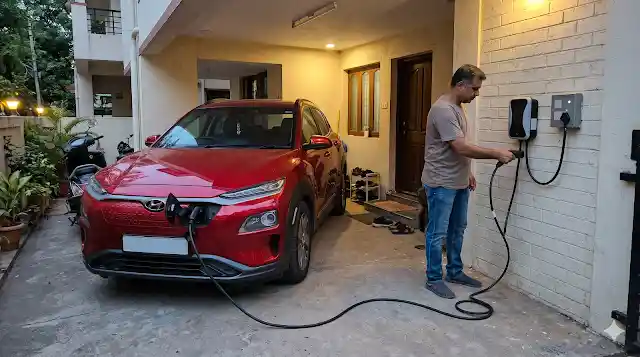
Now plug an EV into a regular 15-amp home wall socket overnight.
Doing 2,600 km takes roughly 380 units of electricity. Even if your local power board charges eight rupees a unit, your entire monthly running bill comes to barely ₹3,000.
Straight up, that leaves roughly ₹16,000 sitting in your pocket every month compared to petrol. Across four years, that is more than eight lakh rupees saved on fuel alone. Throw in zero oil changes, no spark plugs, no air filters, and zero clutch wear, and the real savings easily clear ten lakhs.
The vehicle basically buys itself while you commute. Check our detailed guide on real ownership costs across petrol, hybrid, and electric cars to see how these service bills add up over time.
That ₹20 lakh price gap is practically gone
A couple of years back, petrol buyers had a point. Electric versions of typical sub-four-metre cars cost four or five lakhs more than their petrol counterparts.
That gap has shrunk massively now.
Under twenty lakhs, cheaper localized battery packs have brought on-road EV tags right next to top-spec petrol automatics. Add the road tax waivers in several states, and the difference is barely noticeable.
Already looking at the Curvv or other sub-₹15 lakh crossovers? That tiny price gap disappears within twelve to fifteen months of daily office runs.The warranty angle nobody talks about
Next time you visit a yard, look at the warranty brochure of any petrol or diesel car.
You usually get three years or one lakh kilometres. If you want five years, they make you pay for extended packs.
With electric platforms, brands give you eight years or 1.6 lakh kilometres on the battery and motor right out of the box. Some even offer fifteen-year coverage on localized packs.
Why? Because an EV motor has around twenty moving bits. A turbo-petrol has over two thousand tiny parts rubbing together under intense heat. There are no gaskets to blow, no injectors to choke on bad fuel, and no particulate filters to clog up.
Who should stay away from an EV?
Electric cars make complete sense for high-mileage drivers, but they aren’t for everyone. Walk away if your setup looks like this:
- Low daily running: If you only do twenty kilometres a day to the local market, your petrol bill is hardly four grand a month. You won’t recover the upfront cost for a decade.
- No home plug: If you live in a society that refuses a basic 15-amp parking socket, don’t buy one. Standing at public fast chargers twice a week ruins your peace of mind and costs three times more.
- Deep rural driving: If your work takes you into remote villages with terrible power cuts and no proper earthing, stick with petrol or diesel.
Before you take delivery of any high-mileage EV, go through a thorough electric vehicle PDI checklist to inspect paint finishes, battery seals, and the charging bundle in proper sunlight.
If you have home charging and do 100 km daily, stop pouring hard-earned cash down fuel station drains out of old habit.
100 km Daily Driving: EV vs Petrol – Frequently Asked Questions
1. Is an electric car actually cheaper if I clock 100 km daily?
Way cheaper. Run 100 km every single day in a standard petrol car, and you will easily blow ₹18,000 to ₹20,000 each month at the fuel station. Charge an EV at home on a standard 15A wall socket overnight, and that whole monthly bill drops down to barely ₹3,000. You keep roughly ₹15,000 extra sitting in your bank every single month.
2. How does the car end up paying for itself in four years?
It comes down to simple arithmetic. Doing roughly 2,500 to 2,600 km every month saves you nearly two lakh rupees a year on fuel alone. Across four years, that is about eight lakhs right there. Add the fact that you aren’t paying for engine oil, coolant top-ups, spark plugs, or clutch wear, and your total savings comfortably cross ten lakhs. That easily clears a massive chunk of your original showroom invoice.
3. Why not just pick up a factory-fitted CNG car instead?
CNG cuts fuel bills, but it completely ruins your daily schedule if you drive long distances. You are still shelling out nine to ten grand a month, plus you waste half your week standing in fifty-car lines at gas stations. With an EV, you plug in when you head to bed and wake up with a full battery every morning. No queues, no drama.
4. How long will the battery pack actually survive?
Much longer than WhatsApp forwards claim. Modern battery packs are thoroughly built for Indian heat cycles. Most manufacturers hand you an 8-year or 1.6-lakh-km warranty right off the showroom floor, with several brands extending that even further on localized platforms. An EV motor has barely twenty moving bits, so you skip the intense heat, carbon grime, and mechanical wear that kills petrol engines over time.
5. Who genuinely shouldn’t buy an EV for daily commuting?
If your daily run is barely 20 or 25 km around local neighbourhood roads, don’t bother — it will take you a decade to break even on the initial purchase. More importantly, if you live in an apartment without dedicated parking and a basic 15-amp socket, steer well clear. Relying entirely on roadside commercial fast chargers is frustrating, expensive, and eats up too much time.
6. Can I just depend on public DC fast chargers?
For highway weekend trips, absolutely. For your daily office grind, definitely not. Public chargers cost three to four times more per unit than your domestic home power bill, which eats straight into your monthly savings. An electric car only makes genuine financial sense when eighty percent of your top-ups happen quietly at home while you sleep.