Kia Syros EV Review – Worth Buying or Not?
Kia has launched the Syros EV in India with an NMC battery. Prices start from ₹13.50 lakh. Let me tell you honestly what this car is like – the good parts, the average parts, and a few things that can annoy you.
Looks
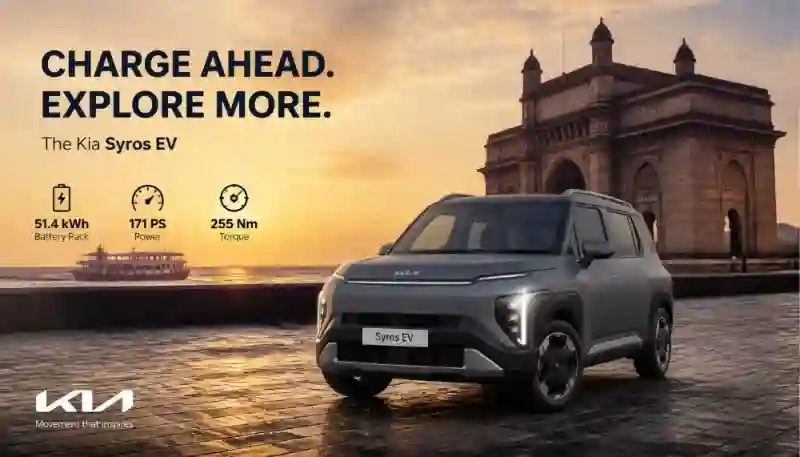
The Syros EV looks bold and boxy. The front has a new diffused Kia badge, ice-cube-style fog lamps, and LED headlamps with DRLs. Body finish feels a bit better than before, almost matte-like.
It is still under 4 metres long, but the cladding and roof rails make it look bigger. Flush door handles, big panoramic sunroof on higher variants, and a projector that throws the Kia logo on the ground at night – these things give it a proper premium feel. At the back, you get a shark-fin antenna, small spoiler, r and different-looking tail lamps. Some people may not like this design. That’s fine; e, it’s personal taste.
Space Inside
This is the biggest surprise. Even though it is a small SUV, the cabin feels really roomy.
Front seats are comfortable and support you well. Higher variants have powered and ventilated seats. Driving position is easy, and you can see outside very clearly because of the boxy shape. I would give visibility 9.5 out of 10.

Rear seats can slide and recline. Even if the front seat is fully forward, there is good legroom. Push the front seat back, and there is still plenty of space. The floor is flat, so the middle passenger also sits without problem. You get rear AC vents, Type-C chargers, an armrest, and even a 220-volt socket. You can run a laptop or small coffee machine with it, or charge a scooter in an emergency. Boot space is 465 litres if you move the rear seats a little forward. That is excellent for this size of car.
Features and Safety
Here comes a big surprise. Even the base variant gets three screens as standard – 12.3-inch touchscreen, 12.3-inch digital instrument cluster and a small 5-inch AC control panel. You don’t have to buy a higher variant just to get the screens. Higher variants add a panoramic sunroof, 360-degree camera, ADAS Level 2, cruise control and more.
Safety is strong. The normal petrol Syros already got 5 stars in crash tests. The EV version should be the same or better. Six airbags, ESC, tyre pressure monitor and other features are there on most variants.
One small issue – some buttons are in slightly odd places. The drive mode button is a bit hidden, the electronic parking brake is placed on the driver’s side in a spot that is not very obvious, and the steering wheel design looks a bit too fancy. New users may take a day or two to get used to them.
Driving, Range and Charging
Motor gives 171 PS and 255 Nm torque. Power comes in smoothly, with no sudden jerks. Steering feels good, and handling is surprisingly sharp. Ride quality is okay – around 8.5 out of 10 – but not the best. Most Kia cars are like that.

You also get paddle shifters behind the steering wheel for regeneration. There are three levels. If you put it on the highest level, it becomes almost like i-Pedal. In city traffic, you barely need to touch the brake pedal. That is very useful in stop-and-go traffic.
Two battery options:
– 42 kWh
– 51.4 kWh (bigger one)
Kia has used an NMC battery instead of the more common LFP. NMC is lighter and more energy-dense. Because of that, even the smaller battery gives roughly 15% better efficiency – around 9 to 9.5 km per kWh. That is a real advantage.
In real life, the smaller battery should easily give you around 400-410 km in city and highway mixed use. The bigger 51.4 kWh pack can do 460-550 km in the city and about 450-480 km on the highway. But remember, if you keep driving at 100-110 km/h on the highway, the battery drains faster. At high speeds,s the range drops noticeably.

Home charging is good. You get a 11 kW three-phase charger as standard. Full charge takes about 4 hours. Fast charging support is up to 100 kW.
Kia is also giving a lifetime battery warranty with unlimited kilometres and 80% buyback after 3 years. That is a big plus and something most companies are not offering right now.
Price and Which Variant to Buy
42 kWh battery
– HTK – ₹13.50 lakh
– HTK+ – ₹15 lakh
– HTX – ₹16 lakh
51.4 kWh
– HTK+ ER – ₹17 lakh
– HTX ER – ₹18 lakh
– HTX+ ER – ₹19.50 lakh
– X-Line ER – ₹20 lakh
If you want the smaller battery, HTK at ₹13.50 lakh looks like the best value. It already gives good range and the main features, including the three screens. If you want the bigger battery, then HTX ER or HTX+ ER make more sense. The top variants feel a bit expensive.
Also Read: Considering other family EVs in this price range? Check out our detailed breakdown on Buying a Petrol Car in India? Go EV! to compare top electric models under ₹20 lakh.
How It Compares
Kia is clearly aiming this car at the Tata Nexon EV and MG Windsor EV. The Syros EV has more space than both in many ways, better efficiency because of the NMC battery, and that lifetime warranty. But the higher variants are priced close to or above some of these rivals, so you have to choose carefully.
Final Opinion
The Syros EV is a proper, mature electric car. Good space, three screens even in the base model, decent range, useful i-Pedal style regeneration, fast home charging and lifetime battery warranty.
Only real complaints are the slightly odd placement of some buttons, ride quality that is just average, and the higher variants feeling a bit costly.
If you need a practical family electric SUV under ₹20 lakh and the bold design does not bother you, then the Syros EV is worth considering – especially the HTK or the mid-range bigger battery versions.
FAQ – Kia Syros EV
1. What is the starting price of the Kia Syros EV?
It starts at ₹13.50 lakh for the base HTK variant with the 42 kWh battery.
2. How many battery options are available?
Two. One is 42 kWh, and the other is the bigger 51.4 kWh Extended Range pack.
3. What is the real-world range?
The smaller 42 kWh battery should give around 400-410 km in mixed city and highway use. The bigger 51.4 kWh pack can do roughly 460-550 km in the city and 450-480 km on the highway. If you drive constantly at 100-110 km/h, the range drops faster.
4. Is the battery NMC or LFP?
It is NMC. NMC is lighter and more energy-dense, so it gives about 15% better efficiency (around 9 to 9.5 km per kWh) compared to most LFP batteries of the same size.
5. Does the base variant also get the big screens?
Yes. Even the base HTK gets three screens as standard – 12.3-inch touchscreen, 12.3-inch digital cluster and a 5-inch AC control panel.
6. How is the space inside?
Very good for a sub-4 metre SUV. Rear seats slide and recline, the floor is flat, and boot space is 465 litres when seats are moved a bit forward.
7. Does it have one-pedal driving?
Yes. There are paddle shifters with three levels of regeneration. The highest level works almost like i-Pedal, so in city traffic you rarely need to touch the brake.
8. How long does it take to charge at home?
With the standard 11 kW three-phase charger, a full charge takes about 4 hours.
9. What warranty does Kia give on the battery?
Lifetime warranty with unlimited kilometres. They also offer 80% buyback after 3 years.
10. Which variant is the best value for money?
For the smaller battery, HTK at ₹13.50 lakh looks like the best value. For the bigger battery, HTX ER or HTX+ ER make more sense.
11. Are there any ergonomic issues?
A few. The drive mode button is a bit hidden, the electronic parking brake is placed in a less obvious spot on the driver’s side, and the steering wheel design looks a bit too fancy for some people.
12. How does it compare with Nexon EV and Windsor EV?
Syros EV has more cabin space in many ways, better efficiency because of the NMC battery, and a lifetime battery warranty. Higher variants are priced close to these rivals, so you have to check features and budget carefully.
13. Is the ride quality good?
It is okay (around 8.5 out of 10) but not the best. It handles corners and steers great, even if the ride itself can feel a little rough.