
⚡ Electric Vehicle Charging Time Calculator
*DC fast charging slows down after 80% due to battery management safeguards.
How the EV Charging Time Calculator India Works
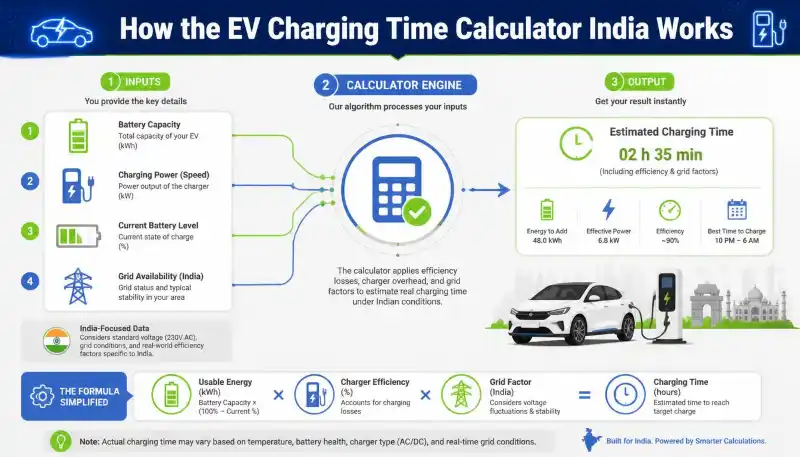
Honestly, one of the biggest questions new electric car buyers have is knowing how long it actually takes to plug in and charge. Our interactive EV Charging Time Calculator India takes the guesswork away by calculating precise charging durations across various battery capacities and power sources.
To use the tool properly, select your vehicle’s total battery size using the slider. Choose your starting battery percentage and your target level (typically 80% for rapid highway driving). Next, select the charging hardware you plan to plug into—ranging from a regular domestic 16A wall socket up to ultra-rapid 120 kW expressway chargers.
Charging Speeds Breakdown: Home Socket vs DC Fast Charger
Look, charging speed is determined by two limits: the output rating of the external charger and the vehicle’s internal onboard charger capacity.
Here is a realistic comparison for a typical 45 kWh battery pack charged from 10% to 80% across India’s charging options:
Charger Category | Rated Power Output | Estimated Time (10% to 80%) | Primary Best Use Case |
|---|---|---|---|
Domestic 16A 3-Pin Socket | 3.3 kW AC | 10 to 11 Hours | Overnight home top-up |
Dedicated AC Wall box | 7.2 kW AC | 4.5 to 5 Hours | Daily home or office charging |
Commercial AC Station | 11 kW AC | 3.5 Hours | Destination malls & hotels |
Public Highway DC Fast | 30 kW DC | 60 to 70 Minutes | Inter-city road trips |
High-Speed DC Hub | 60 kW DC | 35 to 45 Minutes | Expressway transit stops |
Ultra-Rapid Highway Charger | 120 kW DC | 25 to 30 Minutes | Modern high-voltage architecture |
To be fair, DC fast charging slows down after the battery reaches 80% state-of-charge. The vehicle’s battery management system deliberately reduces current to protect internal cell chemistry and maintain pack longevity. For technical charging protocol frameworks, refer to the safety standards outlined by the Bureau of Energy Efficiency (External Link: Open in new tab).
Practical Route Planning and Cost Optimization
Straight up, efficient EV ownership is about building a smooth routine rather than constantly waiting at charging bays:
- Find Highway Plugs: When embarking on long-distance road trips, easily map out verified charging stations along your highway corridor using our live EV Charging Stations Near Me guide.
- Track Fuel Savings: Curious how charging expenses compare to your old petrol, diesel, or gas car? Work out your exact running costs using our interactive EV vs Petrol Savings Calculator.
- Certified Maintenance: If you notice slower AC charging speeds or socket overheating warnings, get your onboard hardware inspected via our verified EV Service Center directory.
Frequently Asked Questions (FAQ)
Why does EV charging slow down significantly after 80%?
Lithium-ion cells absorb power fastest when depleted. Once the battery reaches around 80% capacity, internal resistance and temperature increase. The battery management system reduces the kilowatt intake to prevent overheating and cell degradation.
Can I charge my electric car using a regular home 3-pin plug?
Yes, electric cars can charge from a standard domestic 16-amp industrial-grade socket using a portable 3.3 kW charger. While it takes 10 to 14 hours for a full charge, it is ideal for overnight replenishing.
Does frequent DC fast charging hurt battery health?
Occasional DC fast charging during road trips is completely safe. However, relying exclusively on high-power DC chargers daily can accelerate heat-related battery degradation compared to gentle overnight AC wall box charging.